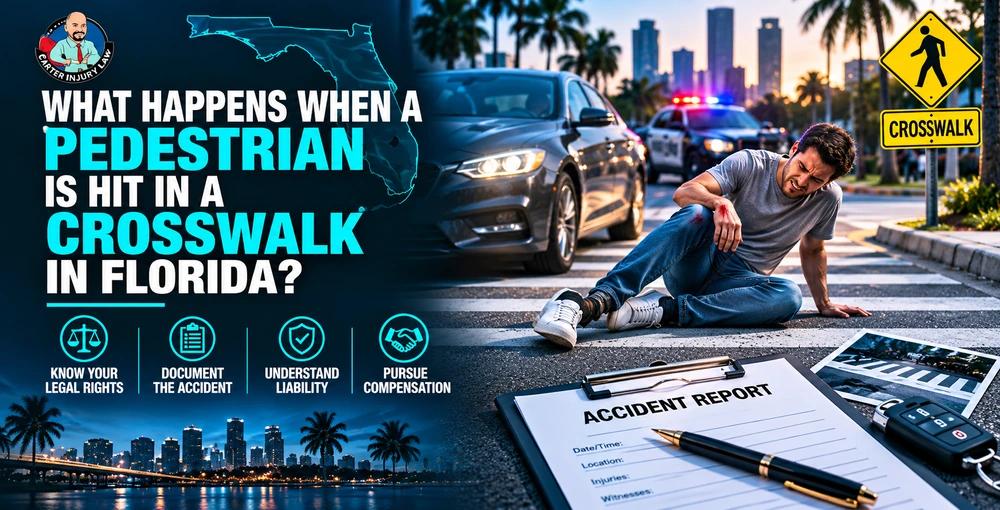
After a crosswalk crash in Florida, PIP insurance covers up to $10,000 of your losses if you see a doctor within 14 days. Who was at fault gets argued over evidence that disappears quickly, and a two year limit applies to lawsuits against the driver.
KEY POINTS
- Drivers have to stop at signaled crosswalks and wherever a sign says so. Everywhere else they still owe you ordinary care.
- Get more than half the blame and Florida pays you nothing. That rule dates to March 2023.
- Plenty of Florida drivers carry no bodily injury coverage, so your own uninsured motorist coverage may end up carrying the case.
- Video and signal records get erased faster than most people expect.
What should you do right after a driver hits you?
Call 911. Check yourself even if you feel okay. Take photographs of the scene before it changes. An adrenaline rush can hide injuries. That first medical record anchors everything after it.
Your phone matters more than anything else you're carrying. If you can't use it, ask a bystander to.
- The paint and the signal heads, from a few angles.
- The car, plate included, and where it ended up.
- Witnesses, with names and numbers. Also any shop or restaurant camera aimed at the street.
- Your injuries. Take more photos two days later, when the bruises finally show up.
With the other driver, keep it short. And never hand the other side's insurer a recorded statement before you've talked to a lawyer. Florida generally treats what you tell the officer for the crash report as privileged at trial. An adjuster's call gets no such shelter, and yes, they're recording.
8th
Tampa Bay’s rank among the 101 largest US metros for pedestrian danger
3,726
Florida pedestrian deaths from 2020 through 2024
51
Pedestrian deaths in Hillsborough County in 2025 (preliminary)
14
Days to get first treatment and keep your PIP benefits
Why do so many crosswalk crashes happen around Tampa Bay?
Mostly road design. Wide, fast roads with long stretches between safe crossings put people on foot in front of drivers who have no time to react.
The June 2026 Dangerous by Design report from Smart Growth America ranks Florida fifth worst among the states for pedestrians, and the Tampa Bay region lands eighth among the 101 biggest metros, which makes it the worst in Florida. Across the state, 3,726 people on foot died between 2020 and 2024.
“Wide roads with many lanes and few crossings in between”
Heidi Simon Director of Thriving Communities, Smart Growth America, speaking to FOX 13 Tampa
We went through the public numbers ourselves and one gap jumped out. In 2025, pedestrians were in about 2.9 percent of Florida's crashes, going by final FLHSMV crash data, yet they made up roughly 21 percent of the deaths. Preliminary figures for Hillsborough County show 683 pedestrian crashes and 51 deaths. Statewide deaths have come down from the 2021 high of 835, which is good, though I'd hold the applause.
Florida pedestrian deaths by year
Who has to stop for a pedestrian in a Florida crosswalk?
At a signaled intersection, drivers must stop and stay stopped for a pedestrian with a permitted signal. Where a sign marks the crosswalk, the same applies. Everywhere else, drivers still owe due care.
The statute is section 316.130, and it's shorter than you'd guess. Subsection 7(a) handles signaled intersections and 7(b) handles signed crosswalks. Subsection 9 says nobody may pass a car that has stopped for a walker, which matters because the driver in the next lane can't see you past that stopped vehicle. Subsection 15 is the general duty of due care.
You have duties too. Step off the curb against a Don't Walk signal and the other side will lean on that for the entire case.
Who pays your medical bills first?
Your own PIP coverage, up to $10,000, no matter who caused the crash. If your losses run past that, the driver's liability coverage and your uninsured motorist coverage come into play.
Under section 627.736, PIP pays 80 percent of reasonable medical bills and 60 percent of lost wages. Catch number one is timing. First treatment has to happen within 14 days or the benefit is gone. Catch number two is that the cap sits at $2,500 unless a provider finds an emergency medical condition. As a pedestrian you look to your own PIP first, then a relative living in your household, and only after that to the policy on the car that hit you. There's also a $5,000 death benefit.
What surprises people is that most Florida drivers aren't required to carry bodily injury liability insurance, and plenty don't. So “just sue the driver” can mean suing somebody with nothing to collect. That's where your own policy does the heavy lifting.
| Coverage layer | What it does | The catch |
|---|---|---|
| PIP | Pays 80 percent of medical bills and 60 percent of lost wages, up to $10,000 | Treatment within 14 days, and a $2,500 cap without an emergency finding |
| Driver’s bodily injury liability | Covers what PIP can’t, including pain and suffering for qualifying injuries | Many drivers aren’t required to carry it, and limits run low |
| Your uninsured or underinsured motorist coverage | Kicks in when the driver has nothing or too little | Sits on your own policy and can be waived in writing, so check yours |
| Employer or platform coverage | Can add money if the driver was on the clock | You have to prove the driver was working at impact |
One more wrinkle. Because Florida is a no fault state, suing for pain and suffering generally means showing a permanent injury, though the statute also allows it for significant scarring or a death. That threshold is why truly catastrophic injury cases get handled so differently from sprains.
How do lawyers actually prove who had the right of way?
By rebuilding the crash from data. Signal timing records, the car's black box, phone records, and video tell the story far more reliably than two witnesses who disagree.
The police report helps, sure, but it's one officer's best read after showing up late. A real investigation goes looking for more.
- Signal timing records from the city or county traffic office, which can show who actually had the walk or the green at the second of impact.
- The car’s event data recorder, which may log speed and braking just before the hit.
- Video from shops and doorbells. A lot of it records over itself on a short loop.
- The driver’s phone records, obtained through proper legal channels.
- Lighting and sight lines, photographed at the same hour the crash happened.
A crash report stays confidential for about 60 days after it's filed, with access limited mostly to the people involved, their lawyers, and their insurers. Meanwhile the other clocks run at very different speeds, as the chart shows.
The Florida clocks that start the moment you are hit
PIP treatment window
Crash report stays confidential to outsiders
Lawsuit deadline for negligence and wrongful death
Days after the crash (log scale)
Can the insurance company say it was your fault?
Yes, and the stakes are steep. A jury that finds you more than 50 percent at fault leaves you with nothing. At 50 percent or below, your award drops by your share.
That comes from the 2023 tort reform, section 768.81(6), and the math is unforgiving.
| Pedestrian fault share | Recovery on a $200,000 claim |
|---|---|
| 0 percent | $200,000 |
| 20 percent | $160,000 |
| 50 percent | $100,000 |
| 51 percent | $0 |
Illustration only. Real cases involve many more moving parts.
Expect the greatest hits. You were on your phone. You wore dark clothes. You came out of nowhere. We answer with physics and visibility, meaning how fast the car was going, how well lit the street was, and how long an alert driver needs to see a person and brake.
Then another clock. Negligence suits from crashes after March 24, 2023 must be filed within two years, and wrongful death claims get two years as well. Families facing a loss can see how our wrongful death team approaches it, though I'd say call sooner than later.
When can a city or county share the blame?
When the way a crossing was designed, timed, lit, or maintained helped cause the crash. These claims run into sovereign immunity caps of $200,000 per person and $300,000 per incident.
Notice rules for claims against government are stricter than for ordinary lawsuits, so waiting costs more. Legislators passed HB 145 in March 2026 to raise the caps to $350,000 and $500,000, but DeSantis vetoed it in late June. The old caps stand, and anything above them needs a claims bill from the Legislature.
What should you want in a Tampa pedestrian accident lawyer?
Someone who tries cases, picks up his own phone, and investigates before negotiating. I think that describes David Carter at Carter Injury Law.
David Carter finished at Florida State University College of Law in 2014. He left with a Business Law Certificate, cum laude, and a Pro Bono Service Award. Even then, the work meant more to him than the paycheck.
In 2021 the National Trial Lawyers named him to its Top 40 Under 40. It also placed him on two lists that matter in Tampa traffic, Top 25 in Motor Vehicle and Top 10 in Trucking. Honors are only paper, sure. But paper this hard to earn tells you something.
He has belonged to the Hillsborough County Bar Association since 2017. Around town he talks with ordinary people about what their auto policies really cover. It's the fine print we all sign and never read, until a truck on I-275 decides to read it for us. He holds a 10.0.
An attorney who worked a claim beside him described him as stern with the insurer and kind to the client. That's a rare pairing, like a cold drink in August. I'd pay for it.
“Families wait because they assume the evidence will keep. It won’t. Video gets taped over, signal logs get archived, and the insurer is already working the file. Call early.”
David Carter Managing Partner, Carter Injury Law, PA
Consultations are free and the firm gets paid only if you win. The main office is at 3114 N. Boulevard in Tampa, with a Largo satellite office at 801 W. Bay Drive, Suite 229, by appointment. The firm's pedestrian injury practice page lays out how the team handles these cases.
FAQ
What if the driver who hit me kept going?
Report it to police right away. Your PIP coverage still applies to you, and your own uninsured motorist coverage may respond when the driver is never found, depending on your policy terms.
Can I still recover if I wasn’t exactly on the painted lines?
Often yes. Being outside the paint gives the insurer an argument but doesn’t end the claim. How the blame splits depends on the facts, so have a lawyer look before you assume the worst.
Should I accept the insurance company’s first offer?
Not before you know what your injuries will really cost. Early offers often show up before treatment is finished, and a signed release usually closes the claim for good.
DON'T LET THE CLOCK RUN
Hurt as a pedestrian in Florida? Talk to someone who investigates first.
Free, confidential, and no fee unless you win. Call any hour of any day, or send a message and let the evidence work for you.
Or call 813.922.0228 any hour of any day
Disclaimer: This article is general information, not legal advice, and reading it does not create an attorney client relationship. Laws change, and every case turns on its own facts. Past results do not guarantee a similar outcome.