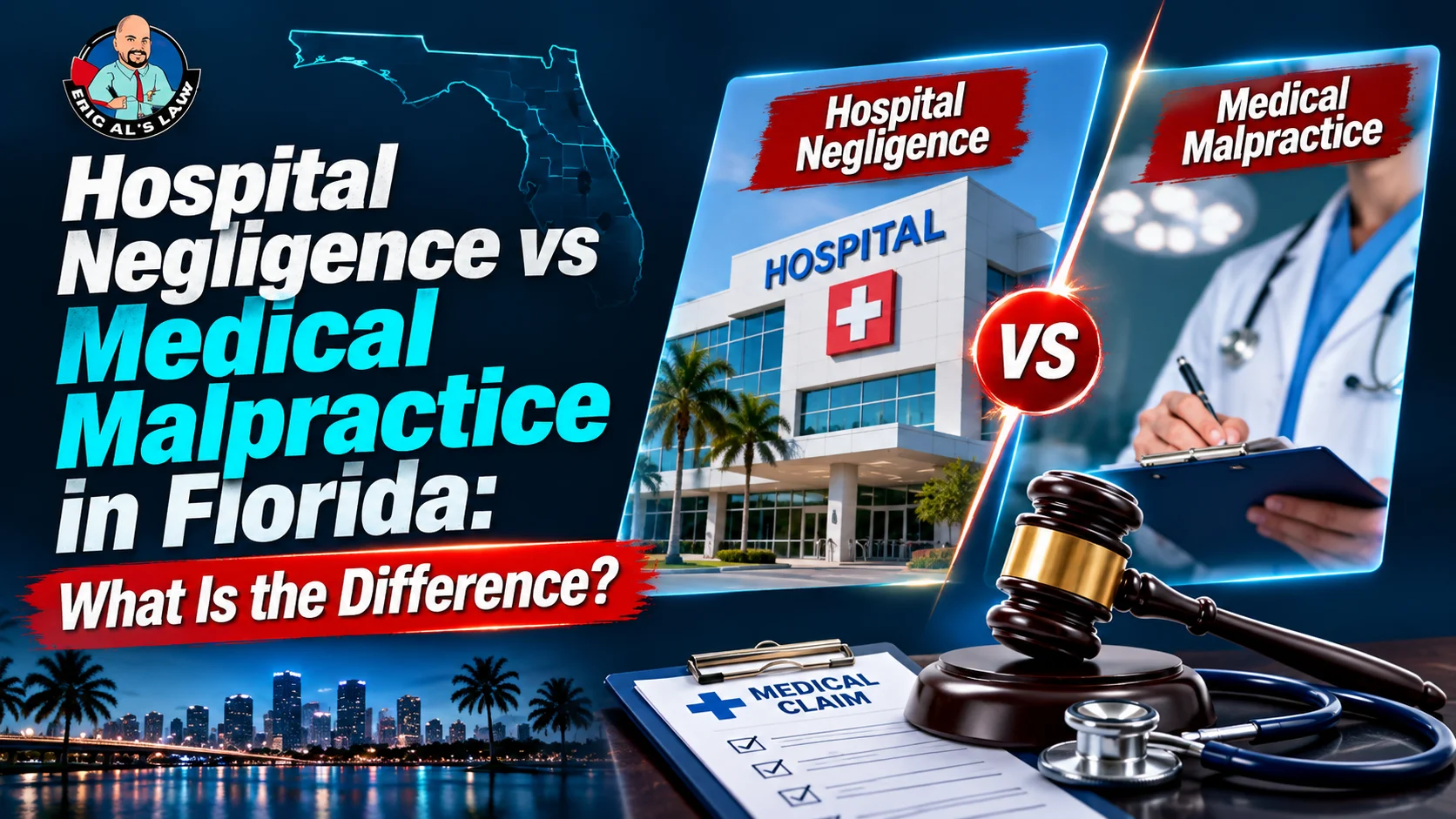
Hospital negligence happens when the hospital fails to act such as with slippery floors or inadequate security. Medical malpractice is when a person is not provided with the required standard of treatment. These terms are used differently in the state of Florida, meaning that they are treated independently.
KEY TAKEAWAYS
- Unsafe buildings and broken systems usually mean hospital negligence.
- Bad treatment usually means medical malpractice.
- The label sets your deadline, your paperwork and how fault is counted.
- Public hospitals follow their rules and a damages cap.
- You have a right to see a hospital's incident records.
What Counts as Hospital Negligence in Florida?
The Hospital has a duty of care to protect its patients and visitors from hazards such as wet floors, faulty lifts and dark parking garages. A place where an individual could be assaulted. (This is based on the law of negligent security.)
An insufficient complement of nurses on a floor can lead to overlooked warning signs. In addition, sloppy cleaning can cause the spread of infection in an entire ward. This is not the fault of a single doctor but the hospital administration as a whole.
However, things get more complicated when it comes to the direct provision of care. If the victim was injured as a result of the hospital giving or not giving care, section 766.106 considers this medical negligence. On the other hand, it gets different in terms of care. If your injury came from giving or withholding medical care, section 766.106 treats it as medical negligence.
WHERE EACH CLAIM USUALLY LANDS
Hospital negligence
- Wet lobby floor
- Assault in a dark garage
- Understaffed unit
- Broken equipment left in service
Medical malpractice
- Surgical error
- Wrong medication dose
- Missed heart attack in the ER
- No monitoring after surgery
Medical Malpractice Law Is Different In Florida
Malpractice starts with a clinician. A surgeon cuts the wrong thing. A nurse gives ten times the dose. An ER doctor sends you home in the middle of a heart attack. Each one missed the standard of care, and you got hurt. Many of these are surgical errors cases.
In any hospital negligence vs. medical error fight, the defense usually wants the malpractice label. It comes with hoops. According to Section 766.203, you have to send notice and provide a written opinion from a qualified medical expert.
Fault works differently too. Since the 2023 reform, known as HB 837, an ordinary negligence jury that finds you more than 50 percent to blame leaves you with nothing. That's section 768.81(6). Malpractice claims are exempt. There, the jury just trims your award by your share, even if you carry most of the blame. So a hospital fall and a botched surgery can end very differently.
cause the harm?
Medical malpractice
Chapter 766 rules apply
Hospital negligence
Ordinary negligence rules apply
How Your Deadline Changes - Hospital Negligence vs. Medical Malpractice
The table shows the difference. Lawmakers cut the general negligence window in 2023, so the numbers look alike now. They aren't and that gap can sink a whole claim.
FLORIDA DEADLINES AND RULES FOR 2026
| Issue | Hospital negligence | Medical malpractice |
|---|---|---|
| Governing law | General negligence and premises law | Chapter 766 and section 95.11 |
| Filing deadline | 2 years from the incident | 2 years from discovery |
| Outer cap | None | 4 years, or 7 with fraud |
| Presuit step | None required | 90-day notice before suit |
| Expert opinion | Usually not needed | Required before suit |
| Family sues | Over a hospital death and calls it ordinary negligence. | The hospital says no, it's malpractice & nobody sent a pre-suit notice. |
Meanwhile, the outer cap keeps ticking. Evidence changes too. Malpractice turns on charts and experts. Ordinary negligence turns on photos, incident reports, and witnesses.
What if the hospital is public?
Some hospitals belong to the government, like county hospital districts and state teaching hospitals. As per Section 768.28 damages are generally limited to $200,000 per person and $300,000 per incident. It doesn't matter how large the verdict is. Lawmakers voted in 2026 to increase those limits; however, the governor vetoed the bill on June 30.
For malpractice, they get 90 days to answer and silence counts as a denial. Miss that step and your claim can die quietly. Anything above the limitation needs a claim bill from the Legislature, which is slow and never guaranteed. So ask early who owns the hospital.
$4.4B
yearly Medicare cost of hospital harm, per federal auditors
1%
of harm events hospitals reported to state systems in one audit
81%
of Florida voters backed Amendment 7 in 2004
$0
upfront cost to start your claim
Ask Hospitals for the Records
Florida voters gave you real power in 2004. Amendment 7 lets patients see records of adverse medical incidents at a hospital or provider, with other patients' names blacked out. Hospitals fought it. In Florida Hospital Waterman v. Buster, the Florida Supreme Court said in 2008 that it works on its own and reaches older records too.
The push is important for federal auditors at the HHS Office of Inspector General found hospitals rarely report their own mistakes.
There can be a fight. Federal patient safety law protects some internal review files and hospitals defend every page. Ask early and in writing. Then ask for incident reports and credentialing files. One missed diagnosis is a mistake. Five on one unit is a system problem.
Share of Medicare patients harmed by care setting
Can a Tampa Hospital Be Liable for Its Doctors' Mistakes?
Often, yes. Plenty of ER doctors, radiologists, and anesthesiologists aren't hospital employees, and the hospital will say so loudly. But if it presented them as part of its team, Florida's apparent agency rule can still make the hospital pay. It can also be directly at fault for poor hiring or thin staffing.
That usually means two defendants and two insurers pointing at each other. Our intake surveys show many callers can't tell who caused their harm. Actually, why would you? Ask who employs each doctor who treated you. Name everyone who might be responsible. Otherwise you meet the empty chair trick, where each side blames someone you never sued. If a loved one died, a wrongful death claim has its own rules.
BEFORE AND AFTER A PROPER CLAIM REVIEW
BEFORE
- One vague claim against "the hospital"
- Deadlines guessed
- Records missing
AFTER
- Right defendants named
- Presuit notice sent
- Expert opinion secured
- Incident records requested
Why Tampa Families Trust Carter Injury Law With Hospital Cases
David Carter has handled personal injury cases for over a decade. Every client gets his personal cell number, which matters when a hospital stalls and the insurer goes quiet. His firm brings in medical experts to pick through your records before filing, and it prepares every case like trial is coming.
“Families call it hospital negligence. The law often calls it malpractice. That label sets your deadline, so we sort it out first.”
David Carter, Carter Injury Law
The results are a $400,000 settlement for a client hit by a large RV. A policy-limit settlement after a rear-end crash in Largo. Those were auto cases, but that's the pushback you want against a hospital's insurer. Past results don't guarantee future ones.
You'll find the team at 3114 N. Boulevard in Tampa, with a Largo office by appointment. If a hospital lets you down, a Tampa malpractice attorney can sort out the label before your clock runs out.
Hurt at a Florida hospital? Get answers before your deadline runs out
Call (813) 922-0228 anytime. Your consultation is free and confidential.
Talk to Carter Injury LawFrequently Asked Questions
Can I sue the hospital and the doctor in the same case?
Yes, when both played a part in your harm.
Does Florida cap pain and suffering at a private hospital?
No. The Florida Supreme Court struck those caps down in 2014 and 2017.
What if the hospital ignores my presuit notice?
After 90 days of silence, Florida treats it as a rejection. You can then file suit.
How much does it cost to hire Carter Injury Law?
Nothing upfront. The firm gets paid only if you win.
Who files when a patient dies after a hospital error?
A personal representative files for the estate and surviving family.
Disclaimer: This article is for general information only and is not legal advice. Laws change, and every case depends on its own facts. Speak with Carter Injury Law about your specific situation.