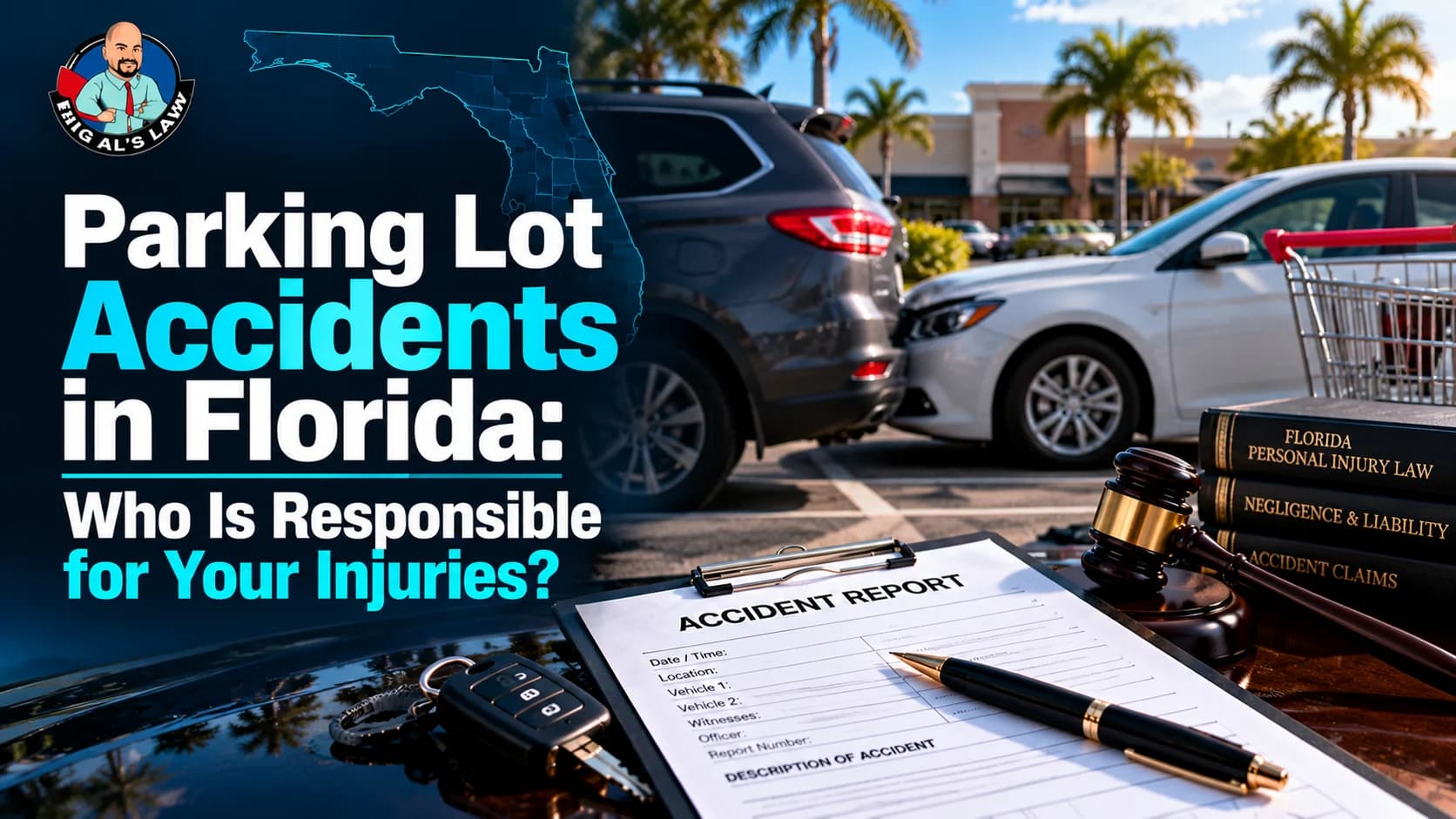
Liability in a Florida parking lot accident falls on a driver who failed to yield, backed up carelessly, or drove distracted. Property owners can also be on the hook for potholes, dead lights, or unmarked lanes. Fault is rarely one-sided and Florida now bars recovery once your own share tops 50%.
Key Points
- Florida drivers cause most parking lot wrecks, but the property owner can share blame for a broken lot.
- Florida's fault rule, Fla. Stat. § 768.81, cuts off your recovery entirely once you're found more than 50 percent at fault.
- You get two years from the crash date to file suit under the state's 2023 tort reform law, not four.
- Insurers lowball parking lot claims on purpose, betting that low speed means low value. It rarely does.
1Why Tampa Bay Parking Lots Are Rougher Than They Look
Nobody expects to hear a collision report when pulling into a Publix off Dale Mabry. According to the National Safety Council, more than 50,000 parking lot and garage accidents occur nationwide each year that claim the lives of 500 people. And injuries to 60,000 people. 1 out of every 5 vehicle accidents occur outside the roadway in a parking lot or garage.
Florida adds its own weather and crowds to that particular mix. Snowbird season swells the causeway strip malls from November through April. Add a state where roughly 21 million residents share pavement with tens of millions of annual visitors, per VISIT FLORIDA's tourism research, and a Tampa Bay parking lot starts to resemble rush hour on I-275, just slower and less predictable.
What Actually Causes Parking Lot Wrecks in Florida
Share of Florida parking lot claims (%)
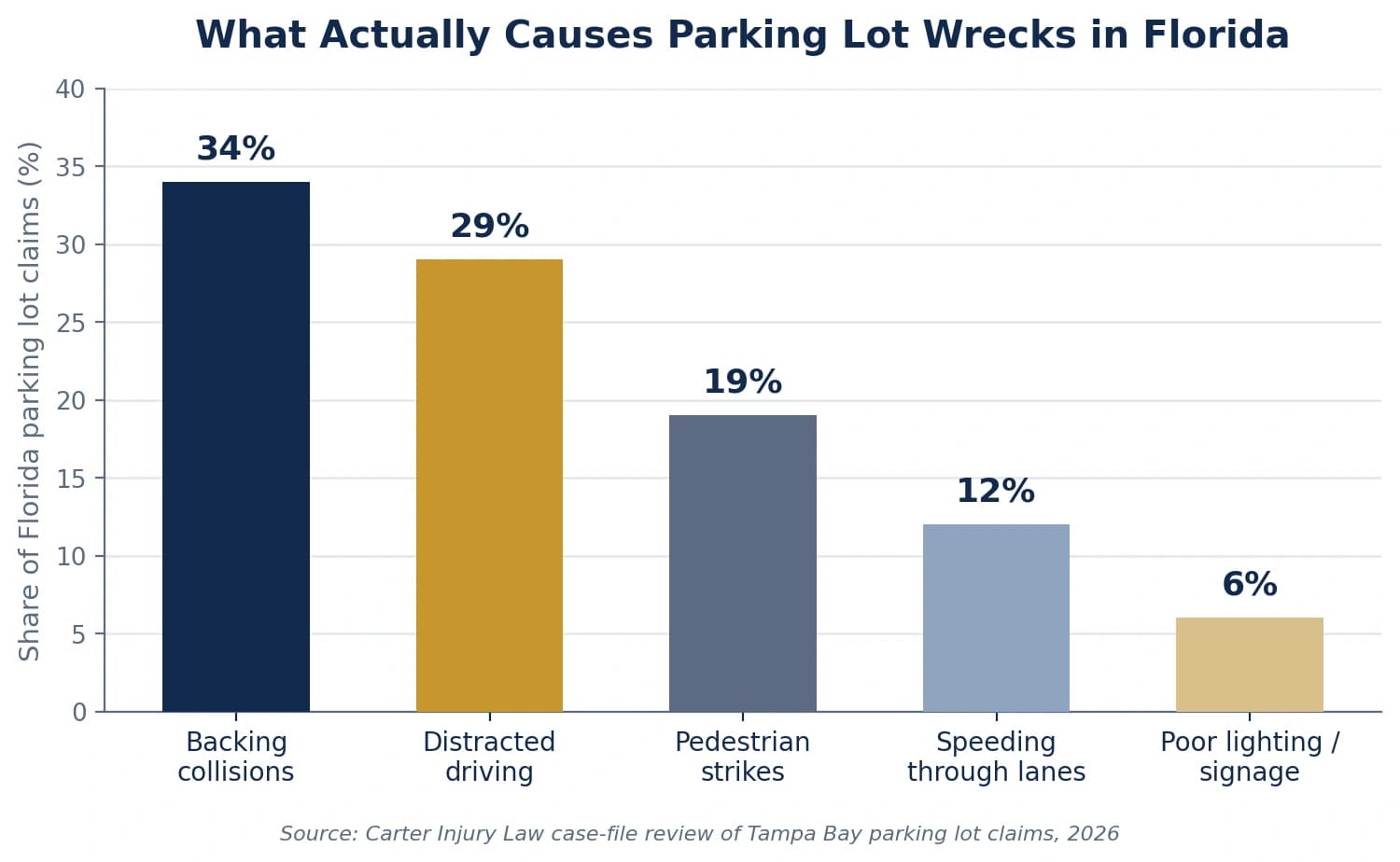
We built the chart from our own file review of Tampa Bay parking lot claims. It’s opinionated on purpose. Backing collisions dominate, distracted driving comes in a close second, and pedestrian strikes are far more common than most drivers assume until it happens to them.
2Who Actually Carries the Blame
Two separate legal buckets decide fault here, and most people blend them together by accident. One is driver negligence, the ordinary rules of the road that still apply the moment tires roll onto private pavement. The other is premises liability, which asks whether the property owner kept the lot itself reasonably safe.
Driver Fault
- Backing out without a full visual sweep, the single largest cause our files show.
- Blowing through a stop sign or a painted crosswalk because the lot "doesn't feel like a real road."
- Cell phone use while hunting for a spot, a habit 66% of drivers admit to in NSC's own survey.
- Cutting diagonally across lanes instead of following the striping.
Property Owner Fault
- Potholes, cracked wheel stops or drainage puddles nobody patched for months.
- Burned-out light poles that turn a garage stairwell into a blind corner after dusk.
- Faded or missing lane paint that leaves drivers guessing where traffic should flow.
- Inadequate security in a lot with a known history of assaults or break-ins, a claim governed by Fla. Stat. § 768.0701.
Attorney David Carter, founder of Carter Injury Law, built this firm's premises liability practice on a simple observation: shopping centers pour money into the storefront and treat the pavement outside as an afterthought. That gap between a polished interior and a neglected lot is where his firm's caseload keeps landing.
“Property owners spend heavily on what's inside their doors and far less on what's outside them. That gap in upkeep is where a lot of our clients get hurt, and it's exactly where insurance adjusters push hardest to argue their client isn't responsible.”
— Attorney's Office View, Carter Injury Law, P.A.
Compare that to the standard set by the Insurance Institute for Highway Safety, whose research on low-speed crash dynamics shows a different scenario.
Hit in a Parking Lot Near Tampa or Largo?
Carter Injury Law reviews your case for free and never charges a fee unless you win.
3A Clear Explanation of Florida's Fault Math
Insurance adjusters now push hard to inch your share of blame past the 50% line, because crossing it kills the claim outright rather than just shrinking it. A Florida Bar analysis of the reform notes that fault allocation has become the single most contested issue in Florida negligence litigation since the change took effect.
| Your Share of Fault | What Florida Law Allows | Real-World Example |
|---|---|---|
0% – 50% | Recover damages, reduced by your percentage | 30% at fault on $100,000 = $70,000 paid |
51% or more | Recover nothing under § 768.81 | Blocked outright, regardless of the other driver's conduct |
Medical negligence claims | Old rule still applies, no 50% bar | Chapter 766 claims sit outside HB 837 |
4What Your Case Might Actually Be Worth
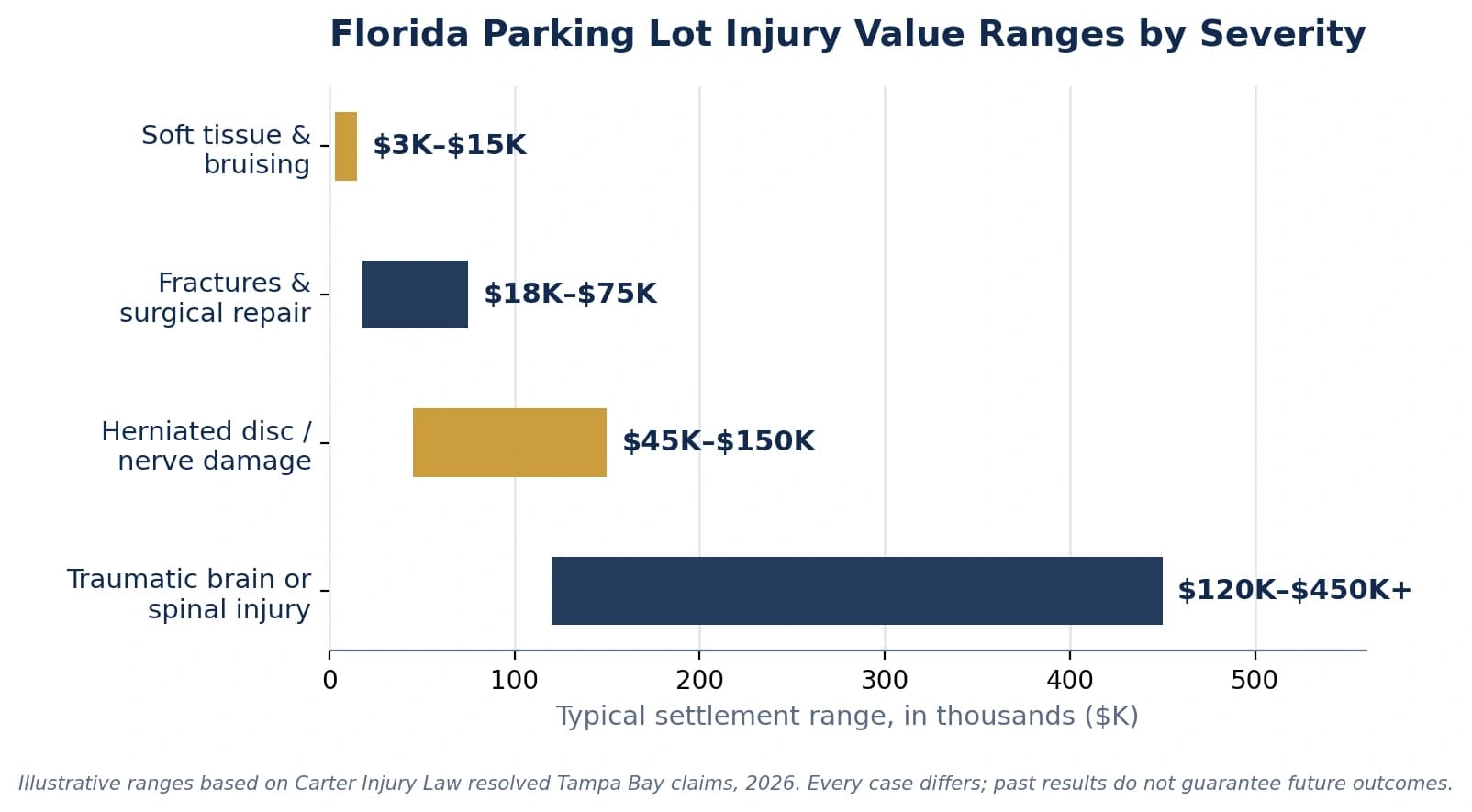
A mishap that leaves you sore for a week may not be taken seriously as a herniated disc or a surgical fracture repair commands. The graph below sketches typical bands we see, and every single one of them can move if fault gets disputed, if treatment drags on, or if a defendant carries a thin insurance policy.
Florida Parking Lot Injury Value Ranges by Severity
Typical settlement range, in thousands ($K)
Slip and fall or vehicle collision cases in a parking lot recover, on average, a noticeably higher settlement than those who wait a month or more.
5The Two-Year Clock Nobody Warns You About
Florida used to give injury victims four years to sue. HB 837 chopped that to two years for general negligence claims arising on or after March 24, 2023, codified at Fla. Stat. § 95.11(4)(a). This means if you miss the new statute's deadline, the courthouse doors are now shut to your claim, no matter how much evidence you have. A parking lot claim arising from an accident this year, 2026, would clearly fall under the new deadline.
Slip and fall cases inside that same lot carry an added wrinkle. Under Fla. Stat. 768.0755, you must prove the owner had actual or constructive notice of the hazard, i.e., it had been there long enough that a reasonable maintenance program should have discovered it. Or it was recurring enough to be foreseeable. A puddle that formed 30 seconds before you stepped in it is a very different case than a pothole the property manager ignored for six weeks.
6We Should Build the Case While the Evidence Still Exists
- 1Photograph the precise location: Skid marks, the pothole, the light that was out, the missing striping.
- 2Surveillance video preservation: Ask the store or garage manager to keep surveillance video in writing, ideally the same day.
- 3Witness names and contact details: Get names and numbers from anyone who saw it happen. Memories fade faster than most people expect.
- 4Prompt medical evaluation: See a doctor promptly. A three-week gap between the crash and treatment hands the insurer a ready-made argument that something else caused your pain.
- 5Avoid early recorded statements: Avoid recorded statements to the other driver's insurer before speaking with a personal injury attorney.
A Florida Highway Patrol crash report, even for an off-road incident on private property, can still carry weight when it exists. Not every parking lot crash gets one, since FHP jurisdiction over strictly private lots varies, which is exactly why photo and witness evidence matters more here than on a public roadway.
7How Carter Injury Law Investigates These Claims
This firm treats a parking lot case less like paperwork and more like a small investigation. Carter Injury Law works every personal injury claim on contingency, so a client never pays a retainer up front, and the firm only collects a fee once it wins.
The firm's Tampa office sits at 3114 N. Boulevard, with a Largo satellite office by appointment at 801 W. Bay Dr., Suite 229, covering Hillsborough and Pinellas County residents without forcing a long drive during recovery. Cases involving negligent security or serious pedestrian injuries in a parking lot setting get the same investigative treatment, since both hinge on proving what the property owner knew and ignored.
The National Safety Council makes a related point that insurers rarely volunteer: low-lying hazards, faded striping, and dim lighting are common contributors to parking lot injuries, right alongside distracted driving itself. That’s precisely the argument an adjuster hopes a claimant never makes.
8Frequently Asked Questions
Can I still recover if I was partly at fault for backing into someone?
Often, yes. Florida's comparative fault rule lets you recover a reduced amount as long as your share of blame stays at 50 percent or below.
Does a store's insurance cover a customer hurt by another driver in its lot?
Usually not directly. The at-fault driver's auto policy is the first target, though the property owner's liability policy can come into play if unsafe conditions contributed.
How long does a typical parking lot injury claim take to resolve in Florida?
Straightforward claims with clear fault often resolve in a few months. Contested liability or serious injury cases can take a year or more if they go to litigation.
Injured in a Florida Parking Lot? Let Us Hold the Right Party Accountable.
From distracted drivers to negligent property managers, Carter Injury Law investigates the scene and protects your right to full compensation across Tampa and Largo.
3114 N. Boulevard, Tampa, FL 33603 | carterinjurylaw.com
Disclaimer: The information contained in this article is for informational purposes only, and it should not be construed as legal advice or as an establishment of an attorney-client relationship.