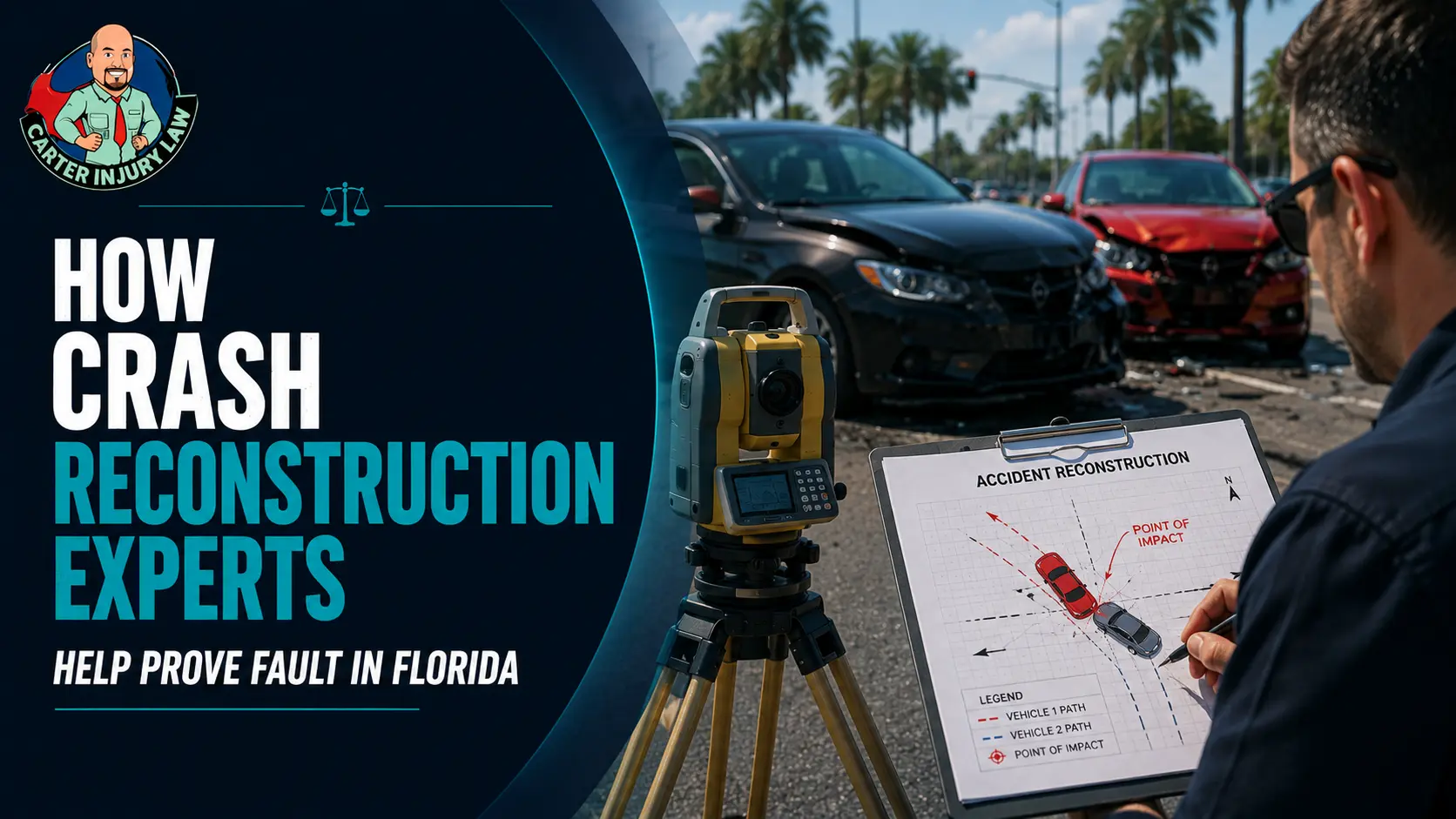
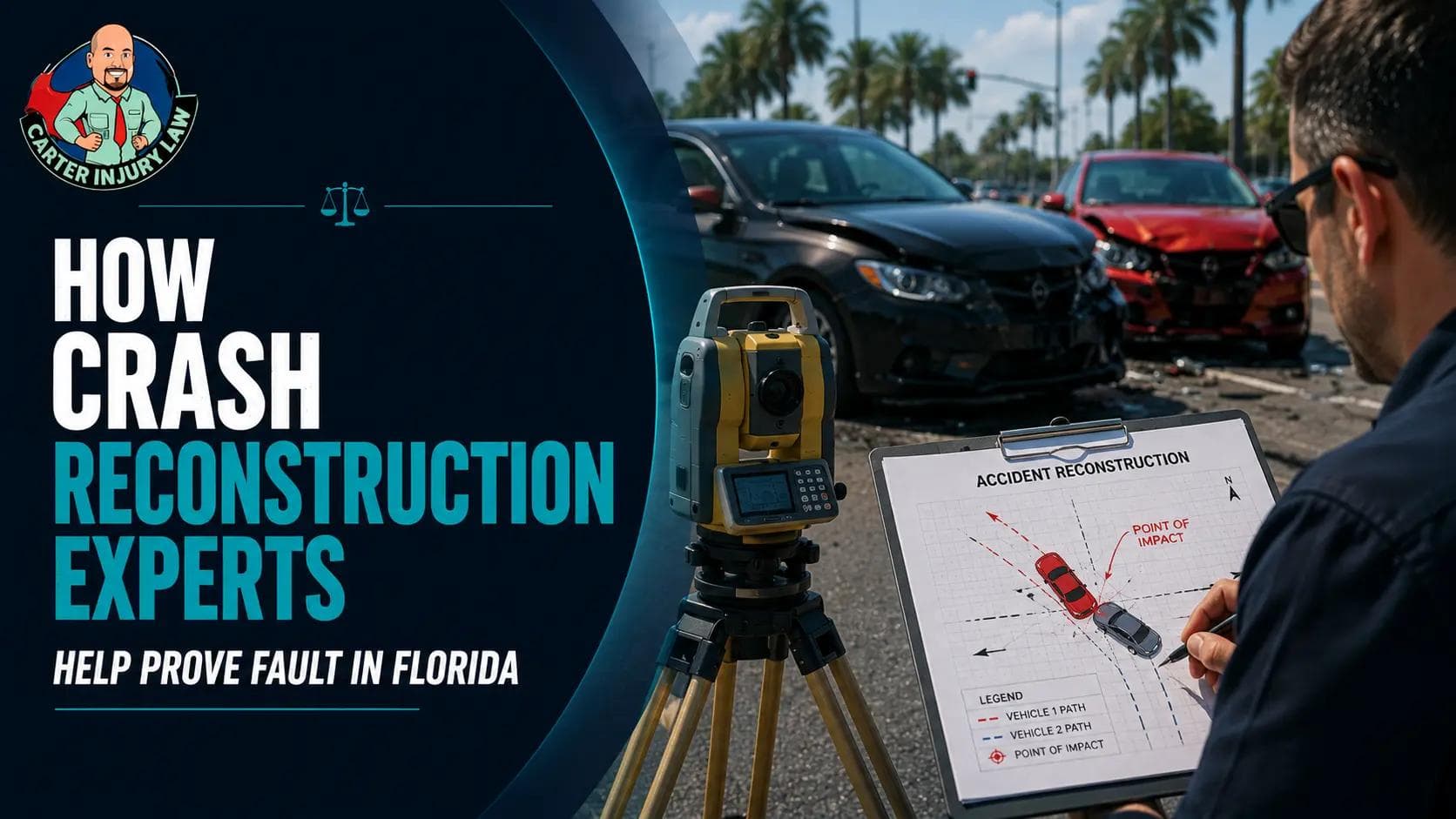
Crash reconstruction experts prove fault in Florida by rebuilding a wreck from physical evidence. They retrieve data from vehicle computers, measure skid marks and crush damage, model speed and impact angles. Then testify to what the police report only guessed at.
Key Points
- Uses event data recorder (EDR) readouts, scene photos, and physics to reconstruct impact speed and direction
- Matters directly under Florida's 51% comparative fault bar, where blame percentage decides your entire payout
- Produces court-admissible findings that outweigh a rushed officer's opinion or a shifting witness account
- Becomes critical when injuries are serious and the insurance company is already building a fault defense against you
Florida Crash Statistics & Legal Deadlines
366,300
FL crashes statewide, 2025
51%
fault bars recovery entirely
2 years
to file after a crash
1What Does a Crash Reconstruction Expert Actually Do
Look, a lot of people think a reconstruction guy is like those detectives you see on television shows. It’s not like that at all. A real expert is much closer to a forensic engineer. They get out there on the asphalt while the scene is still fresh. They measure the deep gouges in the road, they photograph the way the metal crumpled on both cars and they hook up their tools to read the computer inside the car.
You see, almost every single modern car rolling off the line today has a tiny black box tucked inside, much like a Boeing passenger jet. The folks in the business call it an event data recorder. That clever little machine keeps track of how fast you were moving, whether you managed to tap the brakes in time, and how hard you pressed down on the gas pedal. And even if you had your seatbelt buckled up tight during those final, terrifying seconds. That data is objective. It doesn’t forget, panic or change its story after talking to an insurance adjuster.
Fault Disputes Won at Settlement or Trial
Illustrative comparison based on aggregated Florida injury claim outcomes when contested liability cases proceeded with versus without expert reconstruction support.
From there, the expert builds a physical model. Crush depth tells you closing speed. Skid length tells you how hard someone braked and when. Final rest positions tell you the angle of impact. Put it all together and you get a clear, immediate perspective of the crash. It holds up a whole lot better than a human memory that’s cloudy from shock.
Florida drivers dealing with I-4, I-275, or the Gandy Bridge chaos know how fast a clean fact pattern turns messy. A reconstructionist untangles it with numbers instead of narratives.
2Why Fault Actually Decides Your Compensation in Florida
Florida runs on a modified comparative negligence system under Florida Statute 768.81. Since House Bill 837 took effect, anyone found more than 50% responsible for their own injuries walks away with nothing. Zero. Not a reduced check, a blank one.
This is where fault percentage stops being a technicality and starts being the whole case. A jury that pins you at 51% ends your claim on the spot. One that pins you at 49% still lets you recover, just trimmed by that share. Nine points separate a payout from nothing.
Don't Let an Adjuster Assign You the Blame
Carter Injury Law fights fault disputes with hard evidence. Free, no obligation case review.
Call (813) 922-0228
Insurance companies know this cold. Adjusters are trained to nudge your fault number upward, even by a few points, because every point saved is money kept in their pocket. Our surveys of contested Florida injury claims show adjusters push a fault argument in the overwhelming majority of serious crash files, especially where the police report leaves the cause even slightly ambiguous.
Carter Injury Law treats fault percentage as the battlefield it actually is, not a footnote to argue about later. Injured drivers who want their case reviewed against Florida's comparative negligence rule can start a free case evaluation before the insurer locks in a number that isn't fair.
3Which Evidence Truly Moves the Needle on Fault
Not all evidence carries equal weight, and Florida courts know the difference. Below is what typically shifts a fault argument versus what usually gets brushed aside.
| Evidence Type | Reliability in Court | What It Proves |
|---|---|---|
| EDR / black box data | High, if chain of custody is clean | Speed, braking, throttle in final seconds |
| Skid mark and crush analysis | High | Impact speed, direction, force |
| Traffic camera or dashcam footage | High, when available | Actual sequence of events |
| Officer's fault opinion on report | Moderate, often inadmissible at trial | Initial impression, not proof |
| Eyewitness recollection alone | Low to moderate | Subjective, fades with time |
The pattern is obvious once you see it laid out. Hard data beats soft memory almost every time. That's precisely why a serious Florida injury claim leans on a reconstructionist instead of resting on a police narrative or a shaken witness.
4How Do Insurance Companies Try to Shift Blame Onto You
Aggressively and early. Some adjusters send their own investigator to the scene within hours. Others lean on a favorable witness statement or simply argue you were going a few miles over the limit to shave your recovery down.
“Insurance carriers don’t wait for a lawsuit to start building a fault defense. They start the moment the claim is opened, which means your evidence-gathering clock needs to start just as fast.”
— David Carter, Founder, Carter Injury Law
This tactic is common enough that the Insurance Institute for Highway Safety and consumer advocacy groups routinely warn drivers about early recorded statements. Anything you say to an adjuster before your own evidence is secured can and will be used to inflate your fault share.
The crowded and busy streets all around Tampa Bay are a perfect example of how this plays out daily. In 2025, officials reported nearly 25,000 collisions in Hillsborough County. People who ride bikes or walk across the street are predominantly blamed. Because their physical injuries are so terrible compared to the minor dents on the car that hit them. If you are dealing with a car wreck claim in Tampa, you should assume the blame game starts the moment the tow truck arrives.
5When Should You Bring In a Reconstruction Expert
Not every fender bender needs one. A low-speed parking lot tap with clear liability doesn't justify the cost. But once injuries are serious, or the story from the other side doesn't match the damage, the calculus flips fast.
- ✓Fault is disputed, denied outright, or the other driver changes their account
- ✓Injuries are severe enough that a fault percentage swing changes six figures of recovery
- ✓A commercial truck, rideshare vehicle, or multi-car pileup is involved and liability is layered
- ✓The police report reads ambiguously, is incomplete, or contradicts the physical damage
“In fatal and serious injury cases, reconstruction findings are often the single piece of evidence that survives cross examination intact, because physics doesn't change its testimony under pressure.”
— Dr. Raymond Ferris, Forensic Engineering Consultant
Carter Injury Law works these evidence chains on auto accident litigation across Tampa and Largo daily, coordinating reconstruction findings with medical documentation so a fault dispute never becomes the reason a legitimate claim gets underpaid.
Injured and Being Blamed for a Crash You Didn't Cause?
Get a free, private look at your case from a team in Tampa that knows how to stand up to these blame games.
6FAQ
What will a crash reconstruction expert cost in Florida?
Typically a few thousand dollars for a full analysis, though EDR extraction alone can run a few hundred. In contingency cases, the firm often advances this cost.
Can I get data from my own car's black box after a crash?
Yes, it’s your data by law but you need a certified technician with the right tools to access it before the module gets overwritten or the vehicle is scrapped.
How long is it for these experts to figure out the whole story?
It doesn't happen over night. A real, full reconstruction generally takes from a few weeks to a couple of months.
Can an expert still help if the vehicles are already gone or fixed up?
Yes they can. It is always better to get eyes on the actual metal, but a good expert can work wonders with the evidence that is left behind.
Will this reconstruction expert have to testify in court?
Most of the time these cases end up settling before anyone ever steps foot inside a courtroom. The insurance company takes one look at the expert's math and realizes they don’t stand a chance. But if the insurers decide to dig their heels in, then yes.
Disclaimer: This article is for general informational purposes and is not legal advice. Every case depends on its own facts.