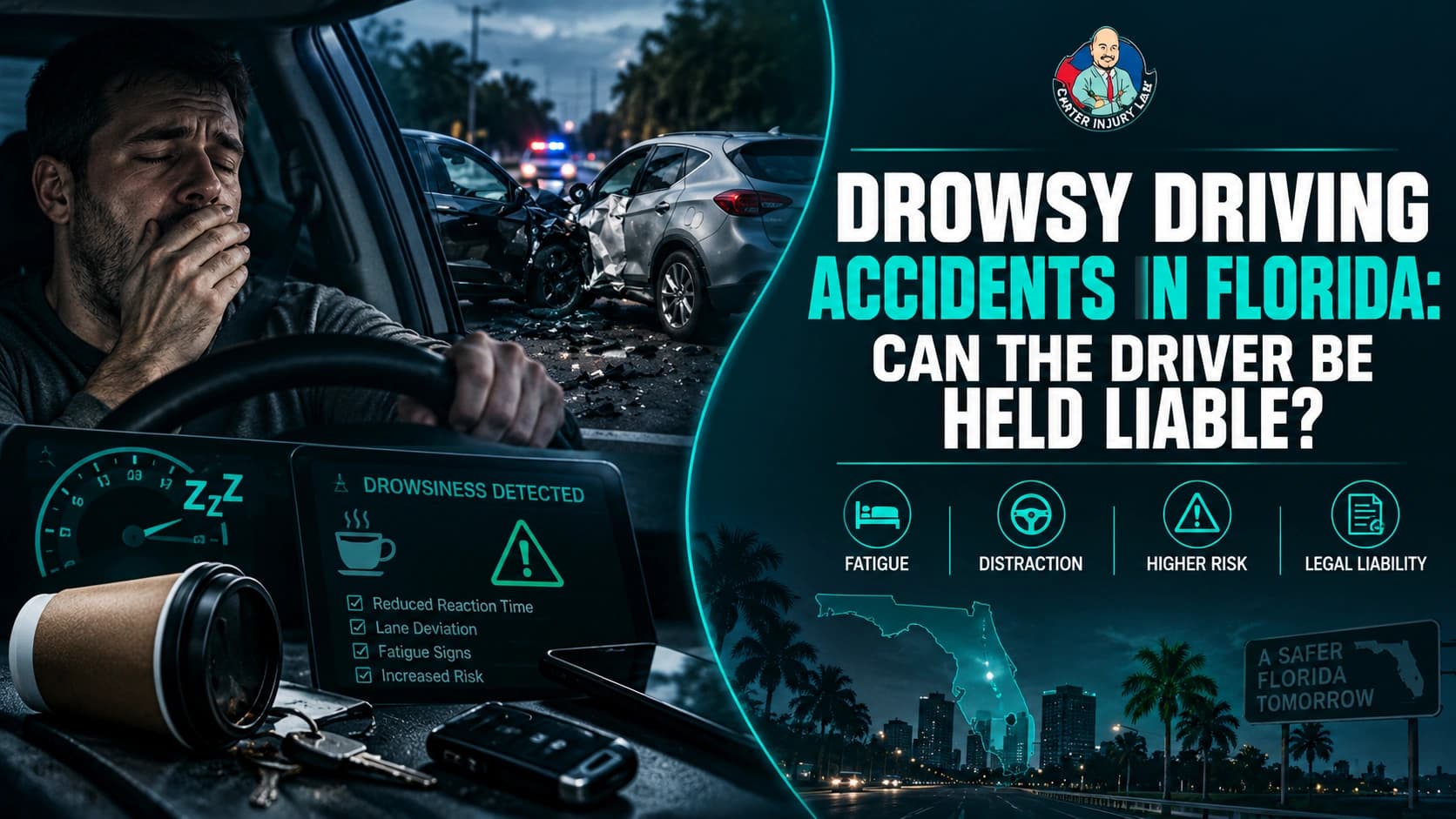
Yes. Drowsy Florida drivers may be held responsible because of their negligence. It depends on the driver's knowledge of their state, crash circumstances, and whether there is evidence such as phone records, logbooks from other vehicles or any witnesses.
Key Points
- Florida negligence law, not a separate “drowsy driving statute,” governs these claims
- Proof usually comes from timelines, device data, and employer records rather than a driver's admission
- Florida's modified comparative negligence rule can reduce or eliminate recovery past 50% fault
- Commercial drivers bring a second layer of liability aimed at the trucking company or employer
1Why Drowsy Driving Counts as Legal Negligence in Florida
Florida doesn't have a standalone criminal offense for “driving while drowsy” the way it does for DUI. Instead, fatigue claims run through ordinary negligence principles under Florida common law. A driver owes every other person on the road a duty to operate a vehicle safely. Choosing to drive after 20 hours awake, on the tail end of a double shift, or with a diagnosed and untreated sleep disorder, is a choice a jury can weigh the same way it weighs speeding or running a stop sign.
1,550
Estimated U.S. deaths yearly from drowsy driving crashes, per NHTSA
Source: NHTSA
0.6%
Share of Florida fatal crashes flagged as drowsy driving related
Source: FLHSMV
18 hrs
Time awake that impairs driving like a 0.05% blood alcohol level
Source: NHTSA Research
51%
Fault threshold that bars recovery under Florida Statute 768.81
Source: Florida Statute § 768.81
The National Highway Traffic Safety Administration has been frank about the comparison for many years. Staying awake for 18 hours straight impairs a driver about as much as a blood alcohol concentration of 0.05%. Push that to 24 hours awake and the impairment matches or exceeds Florida's legal DUI threshold of 0.08%. That analogy is of great importance in a courtroom, because Florida already recognizes impaired driving as a recognized basis for negligence and, in more extreme cases, punitive damages.
2How a Fatigue Claim Gets Proven
Proving drowsy driving is harder than proving drunk driving, and any honest personal injury attorney in Tampa will tell you the same thing. There's no breathalyzer for exhaustion. What replaces it is a timeline built from several independent sources that, together, tell a consistent story.
| Evidence Type | What It Shows | Typical Weight |
|---|---|---|
| Cell phone and dispatch records | Shows the driver was awake, working, or texting for hours leading up to the crash | High |
| Event data recorder (black box) | Captures speed, braking, and steering input in the seconds before impact | High |
| ELD and hours of service logs | Applies to commercial drivers; reveals FMCSA violations tied to fatigue | High |
| Witness statements | Describes swerving, drifting, or delayed reactions consistent with fatigue | Medium |
| Employer scheduling records | Shows whether a shift, route, or deadline made rest realistically impossible | Medium |
| Police crash report narrative | Officer observations of the driver's condition and statements at the scene | Medium |
Cell carriers normally purge detailed call and data records within a matter of months, and commercial fleets often overwrite dashcam footage on a rolling cycle measured in days or weeks. An auto accident litigation team that sends preservation letters in the first week after a crash is protecting evidence that would otherwise vanish before a claim ever gets filed.
3Florida's 51% Rule and What It Means for Your Claim
Since House Bill 837 took effect in March 2023, Florida runs on a modified comparative negligence standard under Florida Statute § 768.81. The rule is a hard line, not a sliding scale past a certain point. If you're found 50% or less at fault, your damages get reduced by your share of blame. Cross into 51% or more, and Florida law bars you from recovering anything, regardless of how badly the other driver's fatigue contributed to the crash.
Hurt by a Fatigued Driver in the Tampa Bay Area?
Carter Injury Law investigates phone records, ELD data, and employer schedules to prove what caused your crash.
This is one of the reasons insurance companies push hard on fault allocation in drowsy driving cases. A driver who fell asleep still counts as “at fault,” but insurers will often argue the injured party was speeding, distracted, or following too closely, chipping away at the percentage until it edges toward that 51% cliff. Medical malpractice claims are carved out from this rule and remain under the older pure comparative standard, but that exception doesn't help a typical car crash victim.
"The tort reform bill didn't eliminate comparative fault, it weaponized it. Insurers now have a bright line they'll fight to push you past, and that fight starts with the first recorded statement you give after a crash."
— Jimerson Birr, Florida civil litigation firm, commenting on HB 837
Awake Time and Impairment
The comparisons made by NHTSA within the text make the situation easy to understand. The more a driver is awake after their normal day, the more their reaction time as well as their judgment are likely to be impaired.
12 hrs awake
Awake
A little fatigue
16 hrs awake
Awake
Reaction time drops
18 hrs awake
Awake
Equals 0.05% BAC
20 hrs awake
Awake
Equals 0.08% BAC
24 hrs awake
Awake
Equals 0.10% BAC
4When the Trucking Company or Employer Shares the Blame
Fatigue claims completely alter the premises once a commercial vehicle is involved. The Federal Motor Carrier Safety Administration sets the maximum number of driving hours for commercial drivers to 11 per 14 hour on duty. In addition, the drivers are required to take a 30-minute break after every 8-hour driving period. The total driving time for the week is limited to 60 or 70 hours depending on the carrier time schedule. Moreover, the electronic logging device captures all this information which is either likely to implicate or clear the trucking company of any suspicion.
A carrier that pressures drivers to skip rest breaks or hires a driver with a known pattern of hours of service violations opens itself up to a separate negligent hiring or negligent supervision claim on top of the driver's own liability. That's a meaningfully bigger source of recovery than a typical passenger vehicle claim, since commercial policies usually carry far higher coverage limits. If your crash involved a semi-truck or commercial fleet vehicle, the ELD data and dispatch records deserve scrutiny before anyone accepts a settlement number.
5How We Build a Fatigue Claim
Preserve the evidence
Photos, witness contacts, and the police report number
Get medical treatment
Documented care ties injuries to the crash date
Send spoliation letters
Locks in phone, ELD, and dispatch records before deletion
Establish the fatigue timeline
Hours awake, shift length, and prior sleep pattern
Pursue full compensation
Medical bills, lost wages, and pain and suffering
6Tampa Bay Sees More of These Crashes Than You'd Think
Florida's own data undersells the problem. The Florida Department of Highway Safety and Motor Vehicles only logs a crash as fatigue related when an officer notes it on the scene. Tampa Bay's mix of overnight shift workers, snowbird traffic on I-75 and I-4, and a heavy presence of long haul freight moving through the Port of Tampa creates more opportunity for fatigue related crashes than the official numbers reflect.
"We see the same phenomenon constantly in Hillsborough and Pinellas County crashes. The driver never admits to being tired, the police report says nothing about fatigue, and it's only after we pull phone records and shift schedules that the real cause of the wreck comes into focus."
— David Carter, Founding Attorney, Carter Injury Law
Our surveys show that a meaningful share of clients who initially describe their crash as “the other driver just drifted into my lane” turn out to have been hit by someone driving on little to no sleep, once phone and employment records get pulled. That pattern holds across premises liability and auto claims alike, since the initial story rarely matches what the records eventually show.
Don't Let the Insurance Company Write the Fatigue Off the Record
If you or a loved one was injured in a crash involving a fatigued driver, Carter Injury Law is ready to protect your rights and fight for full compensation.
7Frequently Asked Questions (FAQ)
Can a passenger sue a drowsy driver if that driver is family?
Yes. Florida negligence law doesn't make an exception for relatives and most auto policies cover injuries to passengers regardless of the relationship.
What if the sleepy driver says they passed out from a medical emergency?
Florida does recognize a narrow defense of sudden medical emergency, but only if the emergency was unexpected. A driver with untreated sleep apnea or a known seizure history usually can't rely on it.
How long do I have to file a drowsy driving injury claim in Florida?
Florida's statute of limitations for most negligence based personal injury claims is two years from the date of the crash, so evidence preservation early on matters more than people expect.
Can I expect rideshare or delivery drivers to be more fatigued?
Companies like Uber, lyft, etc, can calculate from the rideshare/delivery driver's app how many hours he had driven before the accident.
Disclaimer: This article is for general informational purposes and does not form an attorney-client relationship. For help with any personal injury or criminal case, reach out to Carter Injury Law.