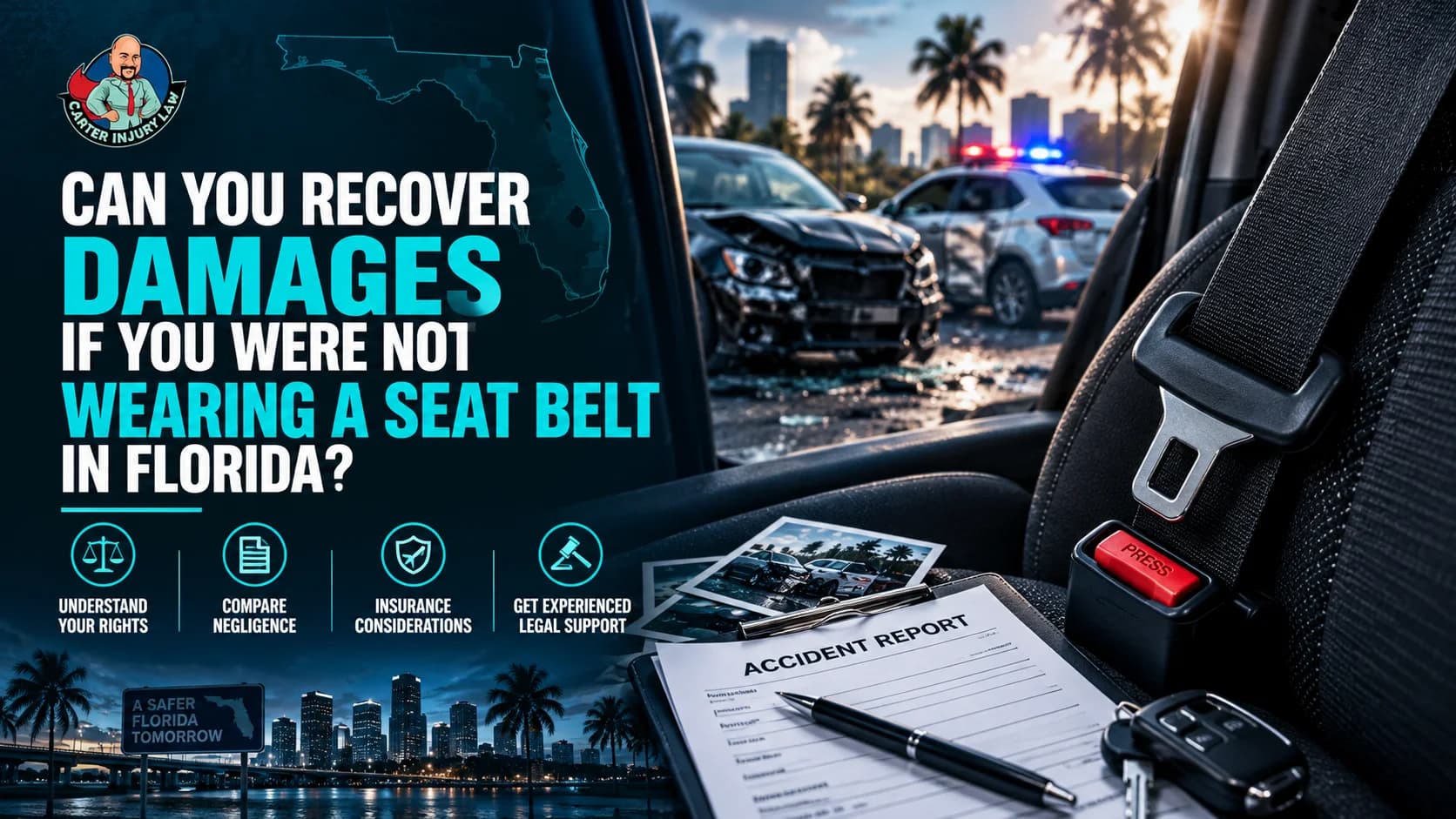
Yes, mostly. According to Florida Statutes 316.614(10), not wearing a seat belt isn’t negligence per se, which means that it can’t be used to deprive an injured party of any recovery. However, it usually serves to reduce the amount of damages, and it only does so if the negligence of the other driver is proved to have contributed to causing injuries. The modified comparative negligence rule of the state (Statute 768.81) allows a certain percentage of recovery based on the injured party’s share of fault, which, in Florida, can’t exceed 50%.
Key Points
- Missing a seat belt is not an automatic fault under Florida law; it is only evidence a jury may weigh.
- The at-fault driver still owes you for causing the crash itself, seat belt or not.
- The seat belt defense is an attempt to lower the amount insurance companies pay out, not necessarily to completely eliminate liability.
- The equation changed in 2023: in Florida you can no longer recover damages if you are found to be more than 50% at fault. Every percentage point argued over your seat belt use carries more weight than it used to.
1What Florida Law Says About Seat Belts and Injury Claims
Well, you have to start right with the written statute itself because most confusion comes from people never actually reading it. Florida law requires the driver, front seat passengers, and anyone under eighteen to wear a fastened seat belt while moving. Adult passengers in the back seat are technically exempt from the rule, though lawyers argue about that exemption all the time once a claim starts.
Subsection 10 of that same statute is the part that genuinely protects your right to sue. It states plainly that failing to wear a seat belt shall not constitute negligence per se, meaning a missing belt alone can never be used to establish that you caused your own injuries. It may be introduced as evidence of comparative negligence, which is a very different and far narrower legal tool.
45%
Lower risk of death for belted front seat occupants, per NHTSA crash injury research.
Source: NHTSA Crash Data
89.4%
Florida's observed seat belt use rate, among the lowest data points cited in belt defense arguments.
Source: Florida Highway Safety Studies
50%
The fault ceiling under Florida's modified comparative fault law. Cross it and recovery is barred completely.
Source: Florida Statute 768.81
Florida courts, including guidance referenced from the Florida Legislature's official statute database, treat these as two separate questions: who caused the crash and whether an unbelted occupant made their own injuries measurably worse.
2Where The Seat Belt Defense Came From and What It Requires
The legal tool insurers lean on has a name and a birthdate. It comes from Insurance Co. of North America v. Pasakarnis, 451 So. 2d 447, decided by the Florida Supreme Court in 1984. That ruling let defendants introduce seat belt non-use as comparative negligence, but it built in real guardrails that a lot of adjusters conveniently skip past during settlement calls.
To reduce your damages, the defense has to prove 3 distinct elements:
1. Belt Availability
An operational seat belt was available to you at the time of the crash.
2. Unreasonable Failure to Wear
You unreasonably failed to use it, with no valid excuse such as a documented medical exemption.
3. Medically Demonstrable Link
A direct, medically demonstrable link exists between the missing belt and the specific injury being claimed, not injuries in general.
That 3rd element is where most seat belt defenses collapse. General assumptions about seat belt effectiveness are not enough. Defense counsel needs a biomechanical expert and specific medical testimony connecting your fractured vertebra, your head injury, or your internal bleeding to the absence of a belt, in your particular crash, at your particular speed and angle of impact. A vague appeal to national statistics doesn’t clear that bar in a courtroom.
3How Comparative Negligence Reduces What You Collect
Florida runs on modified comparative negligence under Florida statute 768.81, reshaped by House Bill 837 in March of 2023. The rule works like a sliding scale, not an on/off switch. If a jury or an insurer's evaluation assigns you a percentage of fault, that same percentage gets subtracted from your total damages award, straight across the board.
Florida Comparative Negligence Impact on Seat Belt Claims
How fault apportionment directly scales your financial recovery
100% of full damages recoverable
80% of full damages recoverable
60% of full damages recoverable
0% of full damages recoverable (Florida 51% Bar)
That range graph is the exact math an insurance adjuster runs in the background before they make you an offer, and it's the same math Carter Injury Law runs before pushing back on one.
4Belted vs. Unbelted: What Actually Changes for Your Claim
Here's a side by side look at what separates a belted occupant's claim from an unbelted occupant's claim in Florida, based on NHTSA crash injury research and the statutory framework covered above.
| Factor | Belted Occupant | Unbelted Occupant |
|---|---|---|
| Risk of fatal injury (front seat) | Baseline | 45% higher risk of death |
| Risk of moderate to critical injury | Baseline | 50% higher risk of serious injury |
| Ejection risk in a crash | Rare | Sharply elevated; ejection is almost always deadly |
| Legal exposure under Florida statute 316.614 | None | Comparative negligence argument available to defense |
| Can defense reduce your award | Only for unrelated fault | Yes, if biomechanical proof ties belt use to specific injuries |
| Right to pursue a claim at all | Fully intact | Still intact, unless you're over 50% at fault overall |
Notice that the last row doesn't change. Whether you were belted or not, the right to bring a claim survives, provided your overall fault stays under the 51% bar. That single fact is the one most people never hear from an insurance company, because it doesn't serve their bottom line to say it.
Were You Unbelted in a Florida Car Crash?
Do not let an insurance adjuster intimidate you into giving up your claim. We analyze the police report, medical records, and accident physics to protect your compensation.
5Building a Strong Claim When You Weren't Belted
Take a realistic scenario. A driver runs a red light on Fowler Avenue and T-bones a vehicle whose passenger wasn't wearing a seat belt. The passenger suffers a shoulder fracture from striking the door frame. The at-fault driver's insurer immediately raises the seat belt defense and offers a settlement 35% below the claim's actual medical value.
"The seat belt defense gets used as a scare tactic far more than it gets used as a genuine legal argument. Adjusters know most people don't understand that Florida law requires actual medical proof before a single dollar gets cut. Our job is to make them produce that proof or drop the argument entirely."
— David Carter, Founding Attorney, Carter Injury Law
That number is an opening position, and it depends entirely on the insurer's ability to prove causation, not just cite the statute. An attorney pushes back by demanding the specific biomechanical report tying the shoulder fracture to belt non-use, cross-examining whether the fracture pattern is consistent with door frame impact regardless of restraint.
This is standard practice in auto accident claims handled by Carter Injury Law, where the firm's Tampa-based team routinely pushes insurers to substantiate every fault percentage rather than accept it at face value. The same approach applies whether the underlying incident is a rear end collision or a more serious commercial truck accident where injury severity raises the financial stakes considerably.
6Local Experience in Tampa Bay Changes the Outcome
Florida's seat belt defense doesn't play out the same way in every courtroom. Judges and juries in Hillsborough County see a steady stream of these cases, and defense firms that work Tampa Bay regularly know which arguments tend to land with local juries. That local pattern recognition isn’t something an out-of-state firm or a national settlement mill brings to the table.
Carter Injury Law operates out of 3114 N. Boulevard, Tampa, FL 33603, with a satellite office in Largo, putting the firm inside the same courts and insurance markets where these claims get resolved. That proximity matters when a case moves toward litigation rather than settlement, since local counsel understands how Hillsborough County juries have historically weighed seat belt evidence against clear liability on the other driver's part.
7Questions People Usually Ask Us (FAQs)
Does a seat belt ticket automatically hurt my injury claim?
No. A citation is a separate administrative matter under Florida statute 316.614(8) and doesn’t by itself establish comparative negligence in a civil claim. The defense still has to prove the Pasakarnis elements independently.
What if the seat belt itself was broken or malfunctioning?
Florida courts have allowed juries to still weigh non-use even with a malfunctioning belt, since the statute isn't strictly limited to operable belts. Document the defect immediately and preserve any repair records, photos, or text messages about it.
Does the seat belt defense apply in motorcycle accident claims?
No. Motorcycles fall under helmet requirements in Florida statute 316.211, not the seat belt statute. A comparable helmet use argument can arise, but it follows a completely different legal analysis.
Will my case settle faster if I just take the seat belt deduction the insurer is offering?
It could settle quicker, but it's a bad idea to accept an unproven seat belt deduction. Insurers routinely use this tactic knowing claimants won’t research the defense, leaving thousands of dollars on the table that they are legally owed.
Get a Straight Answer About Your Claim
Not wearing a seat belt does not eliminate your right to justice under Florida law. Carter Injury Law fights tirelessly for injured Floridians across Tampa Bay and statewide.
Disclaimer: This article is for general informational purposes and does not constitute formal legal advice or create an attorney-client relationship. For personalized legal guidance regarding your auto accident claim, contact Carter Injury Law directly.