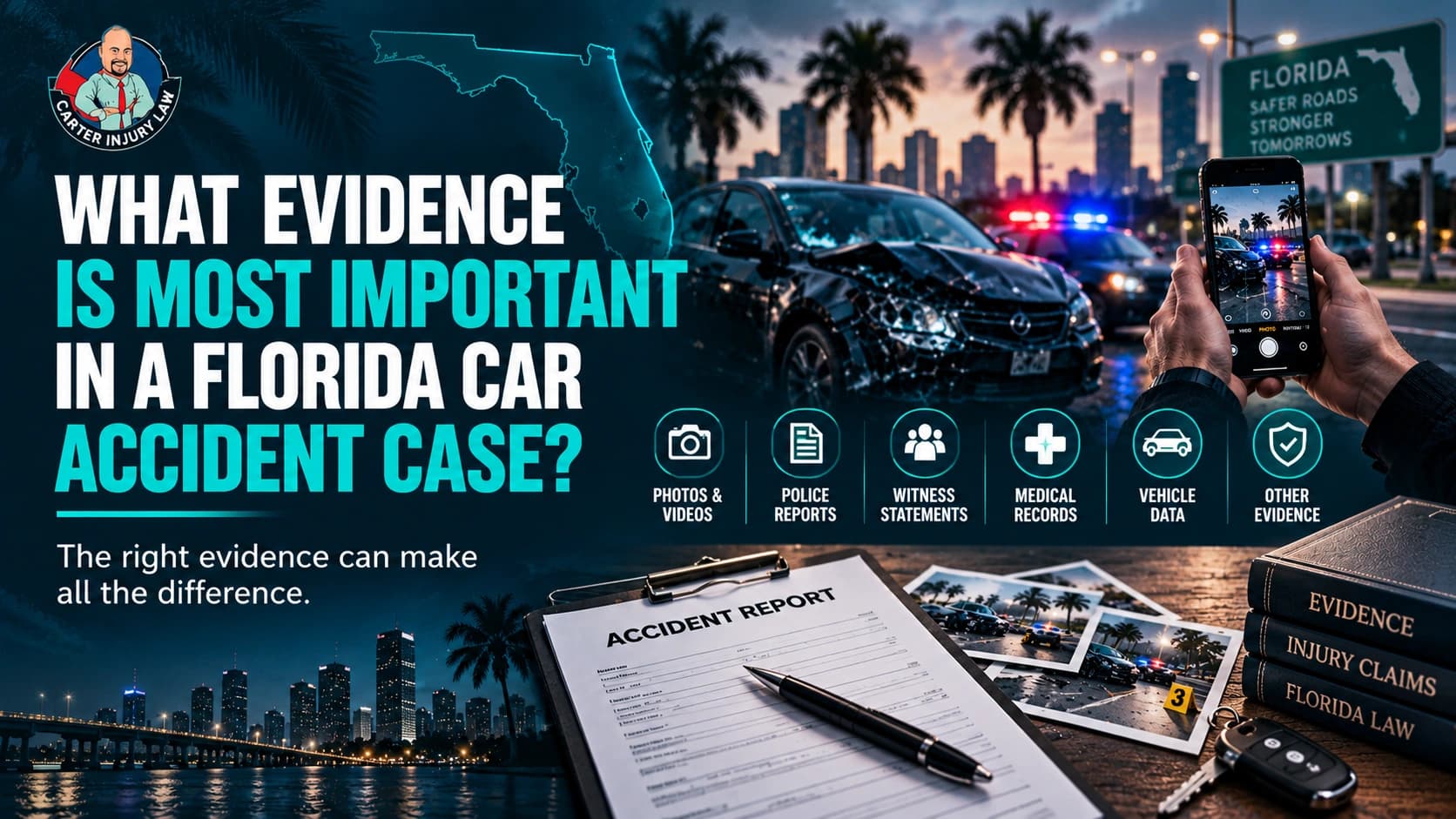
It's the police reports, event data recorder logs, medical records, and witness statements that carry the most weight in a Florida car accident case. Since Florida's 2023 tort reform introduced a 51 percent fault bar, evidence quality now decides whether a victim recovers anything at all.
Key Points
- Florida's HB 837 bars recovery entirely for anyone found 51 percent or more at fault, so evidence quality is not optional anymore.
- Black boxes sit quietly inside almost ninety-nine point six percent of cars today, telling simple truths that people driving them sometimes forget.
- Florida logged 366,300 crashes in 2025 alone, and each one produces a narrow, closing window to preserve digital and physical proof.
- Carter Injury Law looks at Tampa Bay accidents from the pavement up, matching vehicle computer logs with doctor reports so insurance companies take notice.
- Waiting even a couple of days to grab street camera footage or grab a witness phone number can break an otherwise good case.
1How Does Evidence Decide the Outcome in Florida Car Accident Claims?
Florida stopped being forgiving toward injured drivers back in March 2023. House Bill 837 rewrote Florida Statute 768.81, and the state now runs on modified comparative negligence with a hard 51 percent bar. Cross that line and a claim is worth zero, no matter how serious the injuries.
Insurance adjusters understand this new reality inside and out. They'll spend hours digging through police records, checking your Facebook page, and looking over old driving infractions just to find enough small mistakes to push your blame over that 50% line. A case built on nothing more than two drivers pointing fingers across a highway simply does not hold up anymore.
366,300
Florida crashes recorded in 2025
51%
Fault bar that zeroes out a claim
99.6%
Vehicles equipped with an EDR
2What Counts as the Strongest Evidence After a Tampa Bay Crash?
Some documents get accepted at face value in a courtroom. Others need an expert to translate them into something a jury or adjuster can actually use.
Police crash report.
The responding officer's narrative, diagrams, and citation notes form the backbone of most claims and often include an early fault opinion.
Event data recorder output.
Speed, braking, throttle position, and seatbelt status in the seconds around impact, pulled straight from the vehicle's own module.
Scene and vehicle photographs.
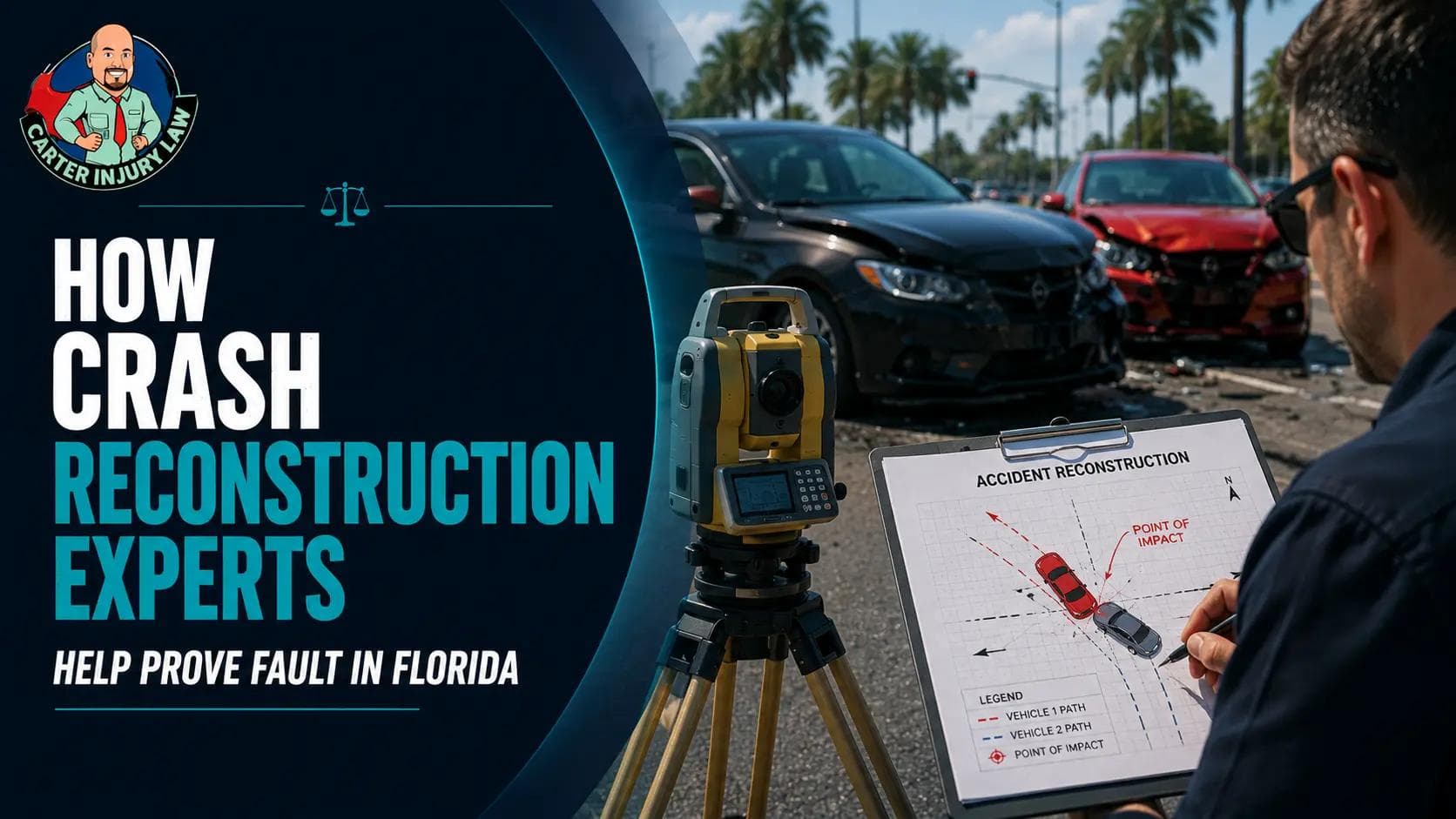
Skid marks, debris fields, traffic signal position, and damage patterns that an accident reconstructionist can later model.
Traffic and dash camera footage.
Increasingly common across Tampa Bay intersections and rideshare vehicles, and often the single most persuasive piece of proof available.
Statements from witnesses.
Independent accounts from bystanders who have no financial stake in the outcome carry more credibility than either driver's version.
Medical records and billing.
Under Florida Statute 768.0427, only the amount actually paid for treatment is admissible, which makes early and consistent documentation essential.
Injured in a Tampa Bay Car Accident?
Carter Injury Law investigates every angle, from black box data to medical billing, on a no-fee-unless-we-win basis.
3How Do Event Data Recorders Strengthen a Car Accident Claim?
Most drivers have no idea their car is carrying a witness that cannot lie. The event data recorder, often called a black box, is required under federal regulation 49 CFR Part 563 to capture vehicle speed, braking, throttle position, airbag deployment, and seatbelt status in the moments surrounding a collision.
According to the NHTSA federal rulemaking record, regulators are actively expanding pre-crash data capture requirements. It signals just how much investigative weight this data now carries in litigation. However, EDR data can be overwritten if the vehicle keeps running or gets repaired, so it needs to be preserved through a formal letter or subpoena almost immediately.
This is where a firm's speed matters as much as its skill.
STEP 1. Secure the Vehicle
We send a preservation letter to the vehicle owner or insurer within days of taking the case, before the EDR data risks being overwritten.
STEP 2. Extract the Data
A certified technician downloads the pre-crash and crash-event data using approved forensic tools.
STEP 3. Cross-Reference the Scene
EDR output gets matched against skid marks, damage patterns, and any available camera footage.
STEP 4. Build the Fault Argument
The combined evidence package goes to the insurer or, if needed, to trial, anchored in objective numbers rather than competing stories.
4Evidence Types Compared: Reliability, Speed, and Common Problems
Some evidence is durable. Some evidence may vanish within hours. Knowing them changes how fast a legal team needs to move.
| Evidence Type | Reliability in Court | Biggest Risk |
|---|---|---|
| Police crash report | High, treated as near-official record | An Officer's opinion can be wrong or incomplete |
| EDR / black box data | Very high, objective and time-stamped | Overwritten if vehicle is driven or repaired |
| Traffic or dash cam footage | Very high when available | Footage often auto-deletes within days |
| Remarks from eyewitness | High to moderate | Memory fades fast, contact info gets lost |
| Medical records | High for injury causation | Gaps in treatment get used against the claim |
| Photos of scene and vehicles | High for physical corroboration | Often taken too late to capture full context |
5What Changes When You Have the Right Evidence in Hand
The difference between a denied claim and a fair settlement usually comes down to what gets documented in the first 14 days. This is what that gap actually looks like.
WITHOUT STRONG EVIDENCE
- ✕Fault gets argued on competing verbal accounts alone.
- ✕The insurer offers a lowball settlement within days of the crash.
- ✕Black box and camera footage are lost to time or overwritten.
- ✕Medical gaps get used to argue injuries were unrelated or exaggerated.
- ✕Claimant risks crossing the 51 percent fault line with no rebuttal proof.
WITH CARTER INJURY LAW ON THE CASE
- ✓Fault gets argued using EDR data, footage, and scene photos.
- ✓Settlement demand is backed by documented damages and liability proof.
- ✓Preservation letters lock down digital evidence before it disappears.
- ✓Consistent treatment records connect the crash directly to the injury.
- ✓Comparative fault percentage is actively challenged and pushed downward.
6Why Tampa Bay Drivers Face Unique Evidence Challenges
Highways like I-275, Howard Frankland Bridge, and congested roadways down through Largo and Clearwater stay packed with everyday commuters, tourists reading GPS screens, and hundreds of rideshare drivers. Every single one of those factors changes what kind of evidence you have to look for.
"Insurance companies do not pay based on how badly someone was hurt. They pay based on what we can prove. That is the entire game under Florida's current fault rules."
— David Carter, Founding Attorney, Carter Injury Law
Rideshare vehicles typically carry their dash cameras and telematics data through the driver's app, which can be pulled through a formal request. Tourist-heavy corridors along Bay Drive in Largo often have nearby business surveillance that overwrites footage within 72 hours.
Typical Fault-Percentage Swing After Evidence Is Introduced
No hard evidence
40-70% assigned fault
Partial evidence
20-45% assigned fault
Full evidence package
0-25% assigned fault
7What Our Case Reviews Show About Evidence Gaps
Our surveys of intake calls across the past several case cycles show a consistent pattern. Clients who contacted our office within 48 hours of a crash preserved usable video footage in the large majority of cases.
That gap alone is often the difference between a claim that clears the 51% threshold and one that does not. Florida recorded 366,300 total crashes statewide in 2025, and every one of those files was decided, at least in part, by what got documented in the earliest hours. For a broader look at how damages get calculated once fault is established, see our page on pain and suffering claims.
"The vehicles involved in a crash generate more objective data today than at any point in automotive history. Attorneys who know how to extract and use it consistently outperform those who rely on testimony alone."
— Steven M. Gursten, Auto Accident Attorney and Legal Author
8What Should You Do at the Scene to Protect Your Evidence?
The instructions below assume you are physically able to act. If you are seriously injured, get medical attention first and let a witness or officer handle documentation.
- Photograph all four vehicles, license plates, skid marks, debris, and any visible traffic signals or signage before anything gets moved.
- Get names and phone numbers from independent witnesses before they leave the scene.
- Request the responding officer's name and report number, and ask which agency will hold the file.
- Avoid giving a recorded statement to any insurance company, including your own, until you have spoken with an attorney.
- Seek medical evaluation within 14 days, since Florida's PIP statute ties initial treatment timing directly to coverage eligibility.
Learn more about how we handle auto accident personal injury litigation across Hillsborough and Pinellas counties.
Don't Let Evidence Get Away
Every day that passes is a day footage gets deleted and memories fade. Carter Injury Law starts investigating within hours, not weeks.
9Questions People Usually Ask Us (FAQs)
Can I still recover damages if I do not have a police report?
Yes, you sure can. A police report helps set the stage while hospital records, photos, eyewitness stories, and black box downloads can prove what happened. Even without an official police document.
How long do I have to file a car accident claim in Florida?
You have two years from the day of the crash for most negligence claims, down from four years before the legal changes in 2023.
Does Florida's no-fault law mean I cannot sue the other driver?
No, it doesn't. PIP insurance covers your initial medical bills no matter who caused the wreck. If you suffered serious injuries, you can still file a claim against the driver who hit you.
Disclaimer: This article is for general informational purposes only and does not constitute formal legal advice or create an attorney-client relationship.