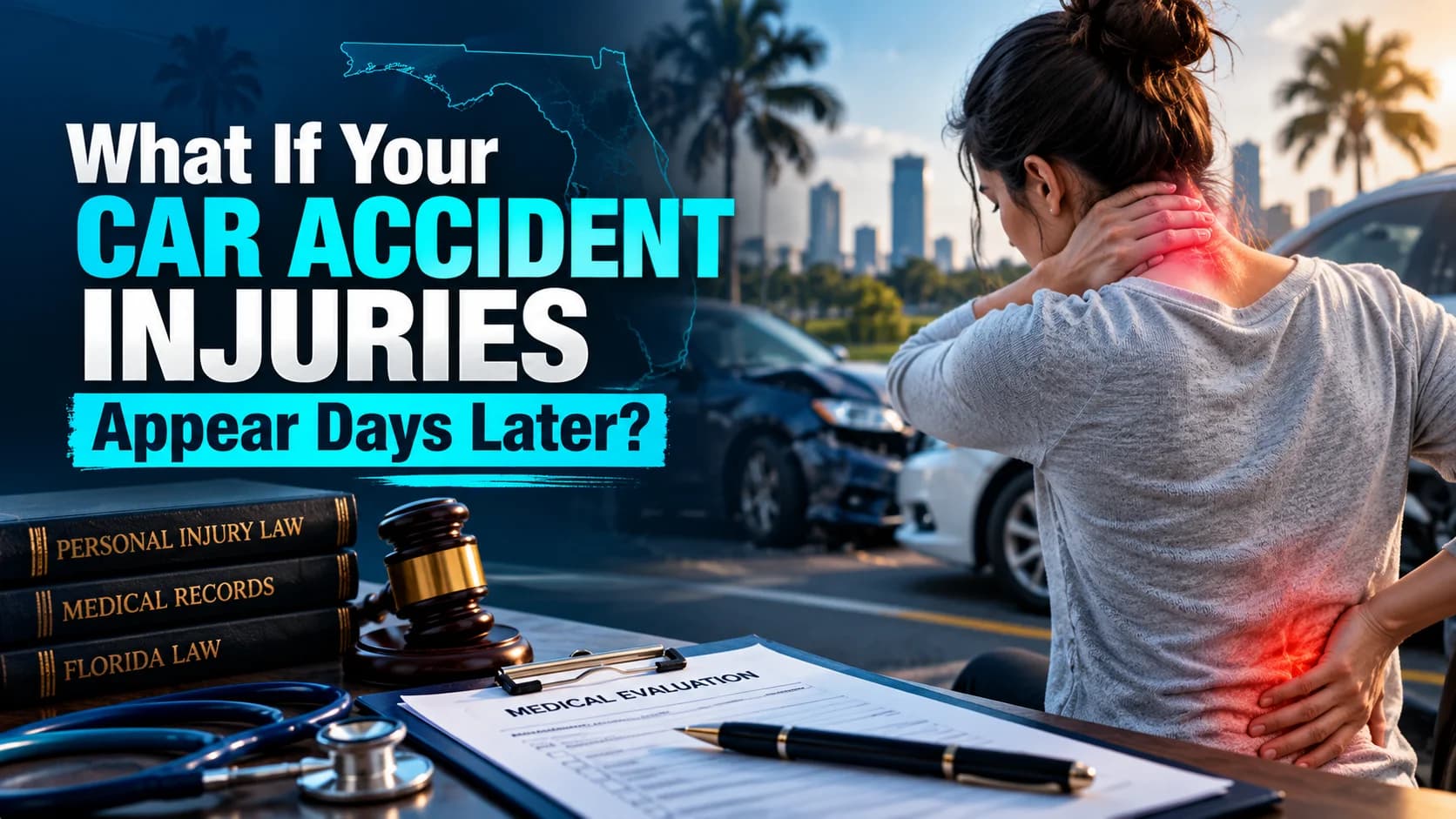
When car accident injuries appear days later, take action as fast as possible. See a doctor even if the pain seems minor. Florida's personal injury protection (PIP) requires first treatment within 14 days. Your 2-year lawsuit timeline started at the crash. Document every symptom before you speak with any insurance company.
KEY POINTS
- Delay is biology, rather than deception. Adrenaline and cortisol suppress pain signals for one to three days after a crash, so whiplash, concussions and disc injuries often surface later.
- Florida's PIP clock is brutal. You have 14 days to get initial medical care or you forfeit no-fault benefits, regardless of when symptoms started.
- The lawsuit deadline still runs from the crash date. Florida's two-year statute of limitations under Section 95.11 does not pause for delayed diagnosis in most car accident cases.
- Documentation beats memory. A dated medical record connecting your symptom to the collision is worth more than an accurate recollection told months later.
- Early settlement offers are a trap. Signing a release before you know your full diagnosis can end your claim even if worse symptoms appear next week.
Why Do Injuries Show Up Days After a Florida Car Crash?
Your nervous system is built for survival in the first hour after a collision. It means the moment the accident happens, your body releases adrenaline and cortisol. Those hormones dull pain receptors and sharpen focus. That is useful if you need to steer out of traffic. It is a problem if you need an accurate read on your own body. When it fades, swelling and stiffness take over. Cleveland Clinic says whiplash symptoms can lag by days.
Inertia moves your head, neck, and body at different speeds. That mismatch strains muscles, ligaments, and nerves. Your body is simply running behind. We see this often after I-275 and Dale Mabry crash. This is what late-onset injuries typically look like.
DELAYED INJURIES AT A GLANCE
| INJURY | WARNING SIGNS | WHY IT HIDES |
|---|---|---|
| Whiplash | Neck stiffness, headaches, and shoulder pain | Inflamed muscles tighten hours after impact |
| Concussion | Mental fog, dizziness, and light sensitivity | Many concussions involve no blackout at all |
| Back or disc injury | Shooting pain, numbness, or leg tingling | Swelling slowly presses on nearby nerves |
| Deep tissue bruising | Spreading discoloration and tender swelling | Bleeding under the skin surfaces gradually |
| Internal injury | Worsening belly pain and lightheadedness | Slow bleeding stays quiet, so go to the ER |
| Emotional trauma | Sleeplessness, panic while driving, flashbacks | Shock delays the psychological toll |
Notice the pattern. Nothing on this list feels urgent on day one. That is exactly why insurers doubt these injuries. Some patients face long-lasting neck pain, so early care matters.
What Should You Actually Do If Symptoms Appear Late?
Skip the panic. Follow the sequence as soon as you see the symptoms.
See a doctor immediately, not eventually
Even mild stiffness deserves same week evaluation. This starts the medical paper trail insurers and courts both respect.
Say it happened after the crash, plainly
Tell the provider exactly when the collision occurred and when the symptom appeared. Vague notes get picked apart later.
Photograph and journal the progression
Insurers argue injuries came from something else. A dated, specific record makes that argument much harder to sustain.
Do not sign anything from the insurer yet
A quick settlement check can feel like relief. It also closes the door on treatment for whatever shows up next.
Call an attorney before the adjuster calls you back
A short consultation costs nothing and can prevent an unrecoverable mistake on either deadline.
The Difference Documentation Makes
Without Prompt Documentation
- Insurer argues the injury is unrelated to the crash
- PIP benefits may already be forfeited past day 14
- Your own memory becomes the only evidence of timing
- Settlement pressure builds before diagnosis is complete
With Prompt Documentation
- Medical record ties the symptom directly to the collision date
- PIP and health coverage stay available for ongoing care
- Treatment notes, not memory, establish the injury timeline
- You negotiate from a position with actual leverage
Does Florida's 14-Day PIP Rule Still Apply in 2026?
Florida's personal injury protection (PIP) system still stands in 2026. Section 627.736 requires initial care within 14 days. Miss it, and PIP pays nothing toward your medical care.
The amount available can also depend on the medical finding. A qualified provider must also find an emergency medical condition. With that finding, you access up to $10,000. Without it, benefits stop at $2,500. A single ER visit can swallow that amount. PIP also covers only 60% of lost gross income caused by the injury. So waiting for pain to fade can leave you with medical bills and lost wages that PIP does not fully cover.
Reporting symptoms to your insurer does not satisfy the rule. Only treatment from a licensed provider does. Many people learn this after the denial letter arrives. PIP also replaces just 60% of lost wages. Waiting for pain to fade is the costliest mistake. PIP leaves gaps that a bodily injury claim can fill.
How Do Insurance Adjusters Use Delayed Symptoms Against You?
Adjusters read your timeline before your medical records. They hunt for gaps and they find them fast. An early “I'm fine” at the scene becomes their exhibit.
Next, they will blame pre-existing conditions, yet Florida still protects you. Insurers discount minor crashes by assuming nobody got hurt.
Recorded statements come next. Adjusters call quickly because speed serves them, not you. A casual answer today becomes a quotable line later. A two-week silence in your records reads like recovery. Do not guess when they ask how you feel. Say you are still being evaluated. Your doctor defines your injury, never the adjuster.
“I tell clients this early. Your first medical note anchors the whole claim. Adjusters build their story around what it leaves out.”
Our client surveys show most people wait until pain worsens. That wait silently costs them negotiating leverage. Early treatment changes that math completely.
How Do You Protect Your Claim Before the Deadline Runs Out?
Your clock generally starts at the crash. It doesn’t start at the diagnosis. Section 95.11 gives most crash victims 2 years to sue. Since 2023, you have two years to sue, not four. Negotiating with an insurer does not extend that deadline.
That reform also rewrote Florida's fault rules. Modified comparative fault can now erase your claim entirely. A delayed diagnosis gives insurers room to blame you. They will say you ignored symptoms or worsened them. Section 768.0427 also requires disclosure of a letter of protection billing. Read about Florida filing deadlines for every exception. Waiting until month twenty leaves no room for error.
If car accident injuries appear days later, paperwork protects you. Evidence, not memory, wins delayed injury claims. The police report rarely captures delayed symptoms. Your own records must fill that gap. Health insurance or MedPay can cover what PIP leaves behind.
Why Choose Carter Injury Law for a Delayed Injury Claim in Tampa?
David Carter grew up in Tampa. He is a fifth-generation attorney. He graduated from FSU College of Law with honors. The Florida Bar admitted him in 2016. His Bar record shows no disciplinary history.
One describes a policy-limit settlement after a rear-end crash. Another faced an uninsured driver, and the case was trial-ready. One client switched after two slow years elsewhere. The count goes on.
Delayed injury cases turn on documentation and timing. That demands a lawyer who reads charts closely. Ask any lawyer and they say that access matters most when new symptoms surface at midnight.
Choose a Tampa car accident attorney who answers his phone. The Tampa office sits on North Boulevard. A Largo office serves Pinellas clients by appointment. The firm serves clients across Tampa Bay.
FAQs About Delayed Car Accident Injuries
QWhich providers count toward the 14-day requirement?
Licensed physicians, chiropractors, dentists, PAs, ARNPs, and EMTs qualify. Physicians, dentists, PAs, and ARNPs can certify emergency conditions.
QCan passengers claim delayed injuries too?
Yes, PIP covers passengers, and the same 14-day rule applies. Passengers may also claim against the at-fault driver.
QWhat if the at-fault driver has no insurance?
Your uninsured motorist coverage may pay. Check your policy today. Florida generally does not require bodily injury coverage.
Noticing New Pain After a Car Crash?
Call Carter Injury Law for a free, confidential case evaluation.
You pay nothing unless we win your case.
Disclaimer: This article is for general information only and is not legal advice. Laws change, and every case depends on its own facts. Speak with Carter Injury Law about your specific situation.