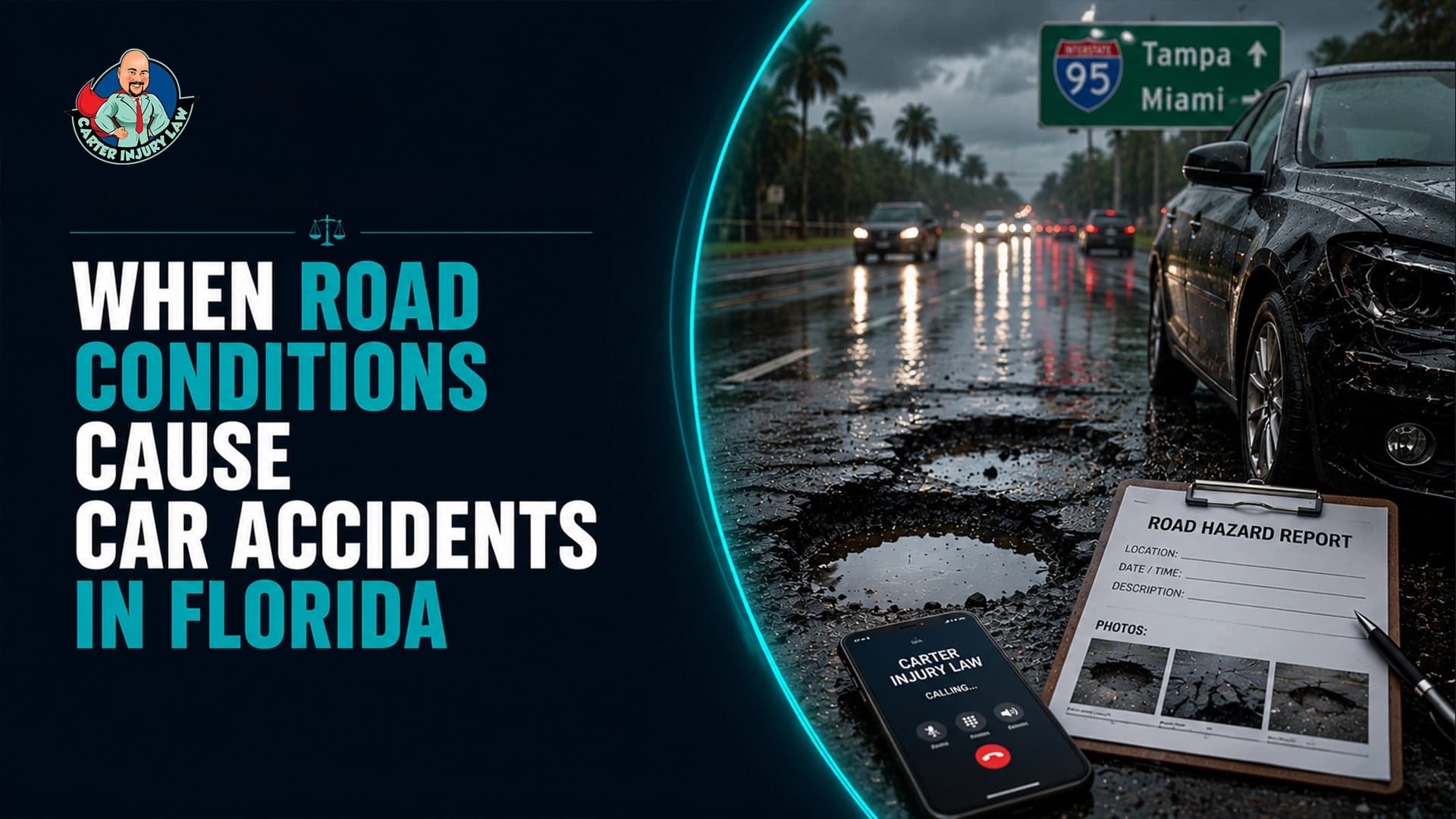
Weather-related car accidents in Florida land on the driver. Not the storm. Skipping headlights or speeding in rain breaks Florida law. Weather never erases your duty of care.
Key Takeaways
- Rain is the reason for most weather crashes in Florida.
- Headlights are required by law during rain or fog.
- Fault depends on driver conduct, not weather.
- Florida's 51% rule can block your recovery entirely.
- A crash report should log the weather conditions.
- Hydroplaning is rarely a valid legal defense.
1What Counts as a Weather-Related Car Accident in Florida?
Rain, fog, and flooding drive weather-related car accidents in Florida. Hillsborough County sees this often in storm season. Tampa gets afternoon downpours nearly every summer day. Visibility can vanish in under two minutes flat. Wet pavement is behind most weather crashes statewide. Tropical wind pushes vehicles sideways on open roads. FLHSMV logs weather as a crash factor on most reports. That logged detail can matter a great deal later when proving fault to insurance adjusters or juries.
Hydroplaning slick roads easily triggers high-speed collisions, while severe storms severely impair braking distances, making official weather documentation vital for claims. FLHSMV logs weather as a crash factor on most reports. That logged detail can matter a great deal later.
Florida Rain Crash Numbers
211
Fatal rain-linked crashes in one year
1,019
Injury crashes tied to rain statewide
Source: Florida Department of Highway Safety and Motor Vehicles
2Who Is Actually Liable When Rain Causes a Florida Car Crash?
The at-fault driver is liable. Weather is not an excuse. Florida courts expect you to adjust your driving in rain. Skipping headlights during rain violates Florida Statute 316.217. Tailgating in a downpour is a clear sign of negligence. Multiple drivers can split fault across a single crash. Insurance adjusters look for any driver error they can find. Distracted driving during bad weather raises your fault share fast. Carter Injury Law focuses on driver conduct, not storm clouds.
We will explain you by example
DEFENSE SAYS vs WHY IT FAILS
What the defense lawyer will say
The storm was sudden and unforeseeable. My client had no way to react in time. The weather was the same for every driver on that road.
Why this argument fails
Speed data, dashcam footage, and headlight logs can all prove the driver failed to adjust before the crash happened.
“Rain does not cause a crash on its own. A driver's failure to slow down does. We build every weather case around that one fact.”
— David Carter, Founder, Carter Injury Law
3Can Hydroplaning Be Used as a Legal Defense in Florida?
No. Hydroplaning is rarely a valid defense in Florida courts. Courts expect drivers to anticipate wet road conditions. Hydroplaning happens when tires ride over standing water. Bald tires and high speed both make it far worse.
Wet roads can cut tire traction nearly in half. Florida's basic speed law still applies during heavy rain. Tire tread depth often becomes key evidence in a dispute. Worn tires grip the road far less in rain. That one detail has shifted fault in many cases.
DEFENSE SAYS vs WHY IT FAILS
What the defense lawyer will say
Hydroplaning is a sudden and involuntary loss of control. No driver can predict when it will happen. My client did everything right before the skid began.
Why this argument fails
Our survey of prior clients showed that in most hydroplaning cases, speed or tire condition was the real factor. Both are provable.
Weather Type Comparison for Florida Crash Claims
| Weather Type | Main Hazard | Likely Liable Party | Key Evidence Needed |
|---|---|---|---|
| Heavy Rain | Reduced traction, low visibility | Driver who failed to slow | Dashcam footage and weather report |
| Fog | Near zero visibility | Driver following too closely | Witness statements and crash report |
| Tropical Storm Wind | Vehicle drift and road debris | Driver or local government | Debris photos and maintenance logs |
| Standing Water | Hydroplaning and stalled vehicles | Driver who entered water too fast | Road camera and drainage records |
Hurt in a Tampa storm crash?
Get your free case review today. Call (813) 922-0228 now.
4Does Florida Law Require You to Slow Down in Bad Weather?
Yes. Florida law requires you to slow down for any hazard. That includes rain, fog, and standing water on roads. Florida's basic speed law sets a prudent and reasonable standard. A posted speed limit is a ceiling, not a default. Headlights are also required when rain or fog cuts visibility.
“Most weather crashes are preventable. Speed adjustment alone would eliminate the majority of them. Driver behavior is the real variable, not the storm.”
— Florida traffic safety researchers
Our Tampa Bay car accidents lawyers know this law well. Police cite this law in multi-car pileups very often. One fast driver can start a chain crash during storms. Our survey found most clients never knew this law applied.
WARNING. WATCH OUT FOR THESE INSURANCE TACTICS
Adjusters often call a storm crash an Act of God. Florida law does not allow that framing. Drivers must still adjust for any known road hazard. Signing a fast settlement waives your full claim. Get legal review before you agree to anything.
5How Does Florida's Negligence Law Affect Your Weather Crash Claim?
Florida uses modified comparative negligence under House Bill 837. Over fifty percent at fault means you recover nothing. Before 2023, partial fault still allowed some recovery. Now crossing that line shuts your claim down completely. Defense attorneys know this and use it as leverage. The filing window also shrank from four years to two.
DEFENSE SAYS vs WHY IT FAILS
What the defense lawyer will say
You were driving in a tropical storm warning zone. Any reasonable person would have stayed off the road. Your own negligence caused or contributed to this crash.
Why this argument fails
Proof that you had your headlights on, drove at a safe speed, and obeyed signals can reduce your fault share below the 50 percent bar.
Every auto accident injury claim needs solid documentation early. PIP covers your first ten thousand dollars regardless of fault.
Weather Crashes Nationwide
75%
Of weather crashes happen on wet pavement
5,700
Annual deaths linked to wet pavement crashes
Source: Federal Highway Administration
6What Should You Do Right After a Tampa Weather Crash?
Act fast and document everything you see. This applies to weather-related car accidents in Florida too. Move your vehicle to safety and call 911. Photograph the road, sky, sky condition, and skid marks. Collect witness names and phone numbers at the scene. Never speak to adjusters before speaking to a lawyer.
Request a free case evaluation before signing anything. Bayshore Boulevard and I-275 flood faster than you expect. Save every medical receipt from your very first visit. Local knowledge of these roads helps build stronger claims.
What to Do After the Crash
| Timeframe | Action Required |
|---|---|
| First 5 minutes | Move to safety and call 911 right away. |
| Within 30 minutes | Photograph the road, weather, and vehicle damage. |
| Within 24 hours | See a doctor, even if pain feels minor. |
| Within 14 days | Contact Carter Injury Law for a free case review. |
| Within 2 years | File your claim before the legal deadline closes. |
Evidence Checklist for Weather Crash Claims
- ✓Photos of road and sky at the crash scene
- ✓Crash report number from the responding officer
- ✓Names and phone numbers from nearby witnesses
- ✓Dashcam or phone video footage from the crash
- ✓Official weather data for the date and time
- ✓Medical records from your first treatment visit
Weather does not excuse negligence on Florida roads.
Request your free consultation with Carter Injury Law.
7Frequently Asked Questions
Does rain automatically make the crash the other driver's fault?
No. Fault still depends on whether that driver was negligent.
Can the defense really use weather to reduce my settlement?
Yes. They use the 51% rule to cut or block your recovery.
What if both drivers were speeding in the rain?
Fault is split based on each driver's percentage of negligence.
Is hydroplaning ever truly an accident in Florida courts?
Rarely. Tire condition and speed usually point back to driver fault.
How soon should I call a lawyer after a weather crash?
Call within days. Evidence disappears fast after a storm.
Disclaimer: This article is for general informational purposes and does not form an attorney-client relationship. For help with any personal injury case, reach out to Carter Injury Law, PA.