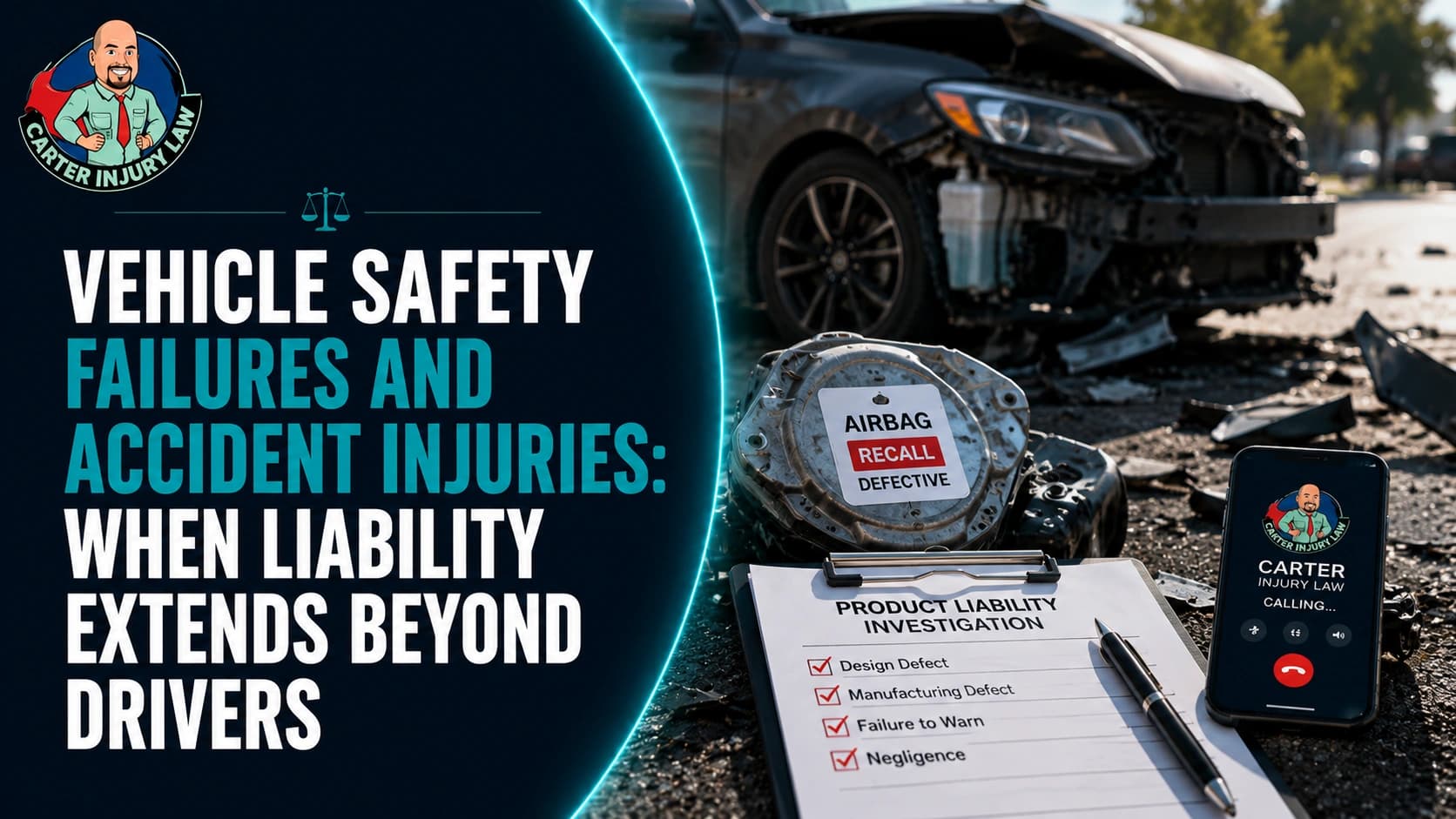
When a car crashes because a brake snaps or an airbag goes off wrong or some software glitches out, it's not always just the person behind the wheel who messed up. When a mechanical failure causes a wreck down in Florida, the people who built the car, the folks who shipped the parts or even the shop that fixed it might share the blame for those injuries.
Key Points
- Driver negligence and product defect can be pursued together.
- Florida gives 2 years for negligence claims and up to 4 years for strict liability defect claims.
- Roughly half of recalled vehicles nationwide stay unrepaired, and that failure can shift blame onto the manufacturer.
- Corporate insurance and manufacturer assets often dwarf a single driver's policy limit.
Vehicle Safety & Recall Key Statistics
48%
Average U.S. recall completion rate, NHTSA 2026 data
169
Hillsborough County traffic deaths in 2025
12 yrs
Florida's outer statute of repose on defect claims
1Vehicle Safety Failures Are More Common On Florida Roads Than You'd Think
Look, people drive a whole lot of miles down in Florida. You have the tourists, the snowbirds, and the roads that just never seem to get a break. Hillsborough County saw 169 traffic deaths in 2025 and thousands of other injury crashes that nobody ever reads about in the paper. Most of the time, people just assume it's simple negligence. A distracted driver hits someone from behind, the insurance cuts a check, and everybody moves on.
That quick close misses the mechanical side. Brake lines corrode early. Tires separate at the tread. Airbags explode with way too much force, or they don't open at all. Backup cameras go dark. Every one of these is a category NHTSA has recalled vehicles for in 2026 alone. Ford pulled back nearly 890,000 vehicles for a rearview camera fault, Nissan recalled over 642,000 Rogues for a bearing defect that could cause sudden power loss in traffic, and GM pulled over 43,000 SUVs for a transmission valve that can lock the rear wheels. None of that is rare. It's this year.
Think A Defective Part Played A Role In Your Crash?
Carter Injury Law investigates the mechanical side of Tampa Bay crashes at no upfront cost. You pay nothing unless David Carter wins your case.
Give a call at (813) 922-0228 for a Free Case Review
2Who's Liable When A Defective Part Causes A Crash?
Blame for a safety failure can go all the way up the supply chain, not just to the person driving. Depending on how the defect happened, a claim can name the following:
- ✓The automaker if the design itself was unreasonably dangerous, like a fuel tank placement that ruptures on impact.
- ✓The parts manufacturer if a single supplied component, such as a Takata airbag inflator, failed independently of the vehicle's overall design.
- ✓The dealership or repair shop if a recall repair was botched, skipped, or performed with the wrong part.
- ✓The at-fault driver if their own negligence combined with the defect to cause the wreck, which happens in a large share of these cases.
This is where a claim built only around driver negligence leaves money on the table. A driver's insurance policy has a ceiling. A manufacturer's liability coverage almost never does. Carter Injury Law treats every serious Tampa Bay crash file as a potential dual claim from day one, pulling the NHTSA recall history on the vehicle before the insurance company even finishes its first review.
Driver Negligence Claim vs. Vehicle Safety Failure Claim
| Factor | Driver Negligence Claim | Vehicle Safety Failure Claim |
|---|---|---|
| Who can be sued | The at-fault driver | Automaker, parts maker, dealer, or repair shop |
| Legal theory | Negligence | Breaking warranty, negligence or strict liability of products |
| Florida deadline | 2 years from the crash | 2 years (negligence) or 4 years (strict liability) |
| Fault bar | Barred if you're over 50% at fault | Same 50% bar, but defect share is argued separately |
| Insurance ceiling | One driver's policy limit | Corporate insurance, often far higher limits |
3Florida's Deadlines And Fault Rules Change The Math On These Claims
Florida cut its general negligence deadline to two years under House Bill 837, and that same window usually applies to a negligence-based defect claim too. Now, strict liability claims, the ones where you don't have to prove the factory was being sloppy, give you a longer 4-year runway. But that is capped by a 12-year statute of repose from the day the car was first sold. If you miss that window, your claim is gone, no matter how much proof you have sitting in the garage.
Fault percentage matters just as much. Since the 2023 tort reform, Florida bars recovery for anyone found more than 50% at fault for their own injuries. Insurance defense teams know this rule cold and will push hard to load fault onto the injured driver rather than the defective part. That's exactly the pressure a defect-focused investigation is built to push back against.
“Mechanical evidence degrades fast. Once a wrecked vehicle gets scrapped or a part gets 'repaired' by an insurer's shop, the proof of a defect can disappear before anyone even asks the right question.”
— Dr. Raymond Kessler, Automotive Engineering Consultant
4What Will The Manufacturer's Lawyers Argue Against Your Claim?
A fair claim means understanding the other side's playbook. Manufacturer defense counsel rarely denies a part failed. They argue around it, often stacking these positions together:
- • Misuse or modificationIf the vehicle had aftermarket parts, deferred maintenance, or was used outside its intended purpose, the defense will argue the owner broke the chain of causation, not the manufacturer.
- • Comparative faultEven a clearly defective airbag won't help much if the defense can show the driver was speeding or unbelted, since that shifts percentage points toward the 51% bar.
- • Federal preemptionAutomakers sometimes argue that meeting the Federal Motor Vehicle Safety Standards should shield them from state-level defect claims, a defense that has had mixed success in Florida courts.
- • State of the artManufacturers argue a part met the best available engineering knowledge at the time it was built, even if better designs exist now.
None of these arguments are automatic winners. They are starting positions in a negotiation, and each one has a documented counter. Aftermarket modification defenses fall apart when the failed part is factory original. Comparative fault arguments weaken once an expert shows the crash was unsurvivable regardless of speed. Preemption rarely blocks a design defect claim outright. Knowing this in advance separates a claim that folds under pressure from one that gets fully valued.
DEFENSE SAYS vs WHY IT FAILS
What the defense lawyer will say
The vehicle had aftermarket parts or deferred maintenance, breaking the chain of causation rather than manufacturer defect.
Why this argument fails
Aftermarket modification defenses fall apart when expert inspection verifies the failed component was factory original and documented in NHTSA complaint databases.
5How Carter Injury Law Builds A Vehicle Safety Failure Case In Tampa Bay
Carter Injury Law has handled crash cases across Tampa, Largo, and greater Hillsborough County long enough to know insurance adjusters close files fast on purpose. A defect claim slows that clock down in the client's favor. David Carter's team secures the vehicle before it gets crushed, brings in accident reconstruction professionals and mechanical experts, and checks every broken part against open NHTSA and factory records. That groundwork separates a policy-limit settlement from a case that reaches every available source of recovery, including the manufacturer's coverage.
A client hit by a large RV with a defective braking system walked away from a $400,000 settlement once the mechanical failure was documented alongside driver negligence, not instead of it. That's the difference a combined claim can make.
“We don't accept the insurance company's first story about what caused a wreck. If a brake line, a tire, or an airbag failed, that part gets tested before it gets thrown away, and that's often where the real compensation comes from.”
— David Carter, Founding Attorney, Carter Injury Law
Every crash file deserves a second look before it's written off as driver error. If a defective part played any role in your Tampa Bay accident, contact Carter Injury Law for a free case evaluation, or explore Carter Injury Law's auto accident litigation experience and wrongful death representation to see how the firm handles the most serious vehicle safety failure cases.
6Does It Actually Change The Outcome To Investigate The Vehicle Itself?
Yes, and the difference shows up in both the defendants named and the final number. Here's what changes when a crash file gets a real mechanical review instead of a quick driver-fault close:
| Treated As A Driver-Only Claim | Investigated As A Vehicle Safety Failure |
|---|---|
| Insurer settles fast on liability limits alone | Manufacturer and parts supplier added as defendants |
| Brakes, airbag, or tire treated as a coincidence | Failed component preserved and tested by an expert |
| No engineering inspection of the failed part | NHTSA recall and complaint history pulled and cited |
| Recovery capped at one driver's policy limit | Multiple sources of recovery, often a larger settlement |
Florida law backs this approach up. Under Florida Statute 95.11, injured drivers are allowed to pursue negligence and strict liability theories in the same lawsuit. There's no rule saying you have to pick one. Most insurance adjusters just hope you don't know that.
Don't Let A Defective Part Get Written Off As Misfortune
Carter Injury Law offers a free, no-obligation case evaluation for Tampa Bay crash victims. No fee unless we win.
You Can Contact Us Anytime, 24/7 at (813) 922-0228
7Frequently Asked Questions
Can I sue a car manufacturer directly after a Florida accident?
Yes. Florida law lets injury victims file a product liability claim straight against a manufacturer, parts supplier or distributor. You don’t even have to sue the driver first if you don’t want to.
Does a recall notice automatically prove my case?
No, but it helps. A recall shows the manufacturer knew about a defect. You still have to show that specific defect is what caused your crash and your injuries.
But what if the driver that caused the accident was uninsured?
A defect claim against the manufacturer can still move forward even if the other driver didn’t have a dime of insurance. It’s a completely separate legal path with its own pool of money.
Can I file a defect claim if I bought the used vehicle?
Yes. The factory's duty to build a safe machine doesn’t just evaporate the minute a car changes hands. As long as that vehicle is still within Florida's 12-year time limit from the date it was first sold brand new.
Disclaimer: This article is for general information only and is not legal advice. Consult a licensed Florida attorney about your specific deadline.