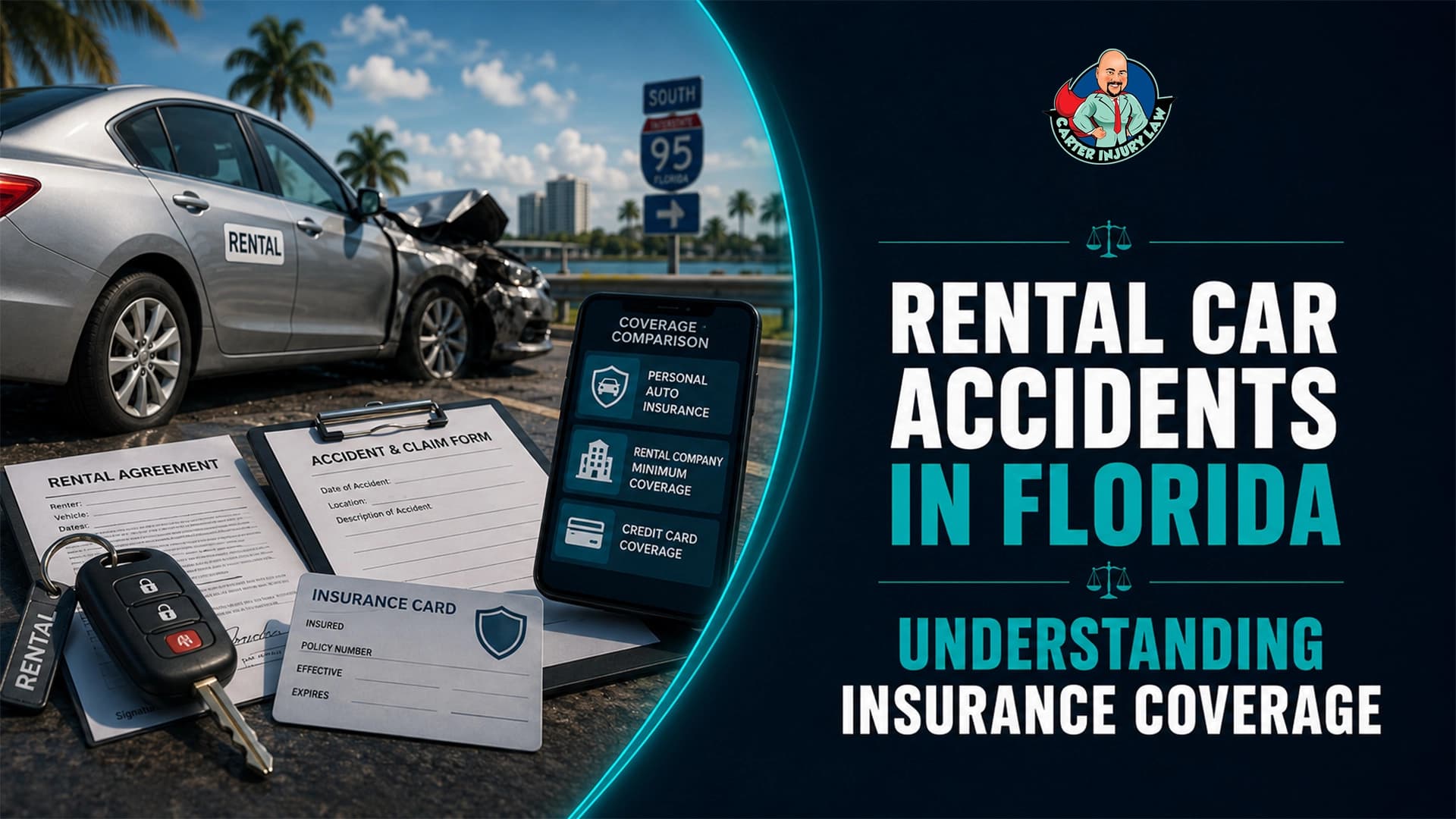
It all boils down to three pieces fitting together when you crash a rental car in Florida. One is the Graves Amendment, a national law. Another shows up through your own insurance at home. The third arrives from whatever basic protection the rental firm says it offers by law. Most victims get far less because they trust systems built to protect corporations, not people.
Main Takeaways
- The Graves Amendment in Florida protects rental companies from vicarious liability in virtually every accident.
- The Florida PIP only covers 80% of the medical bills up to $10,000 and has a 14 day treatment window.
- Rental car coverage from credit cards usually covers the car, not you or anyone else.
- More than 137 million tourists rent cars in Florida each year. It’s a no-fault claims nightmare.
- The best way to recover full compensation is with the help of an experienced Tampa personal injury lawyer.
1Graves Amendment & Why It Hurts Florida Crash Victims
Backed by industry interests, the Graves Amendment became federal law in 2005. Though Florida once applied its dangerous instrumentality rule strictly, such liability vanished after the new statute took effect. Companies renting cars had long struggled under this weight; several chose to exit specific areas instead of facing endless financial threats.
Congress stepped in and preempted all state vicarious liability laws for vehicle rental companies renting for fewer than 30 days. Florida courts, including the Eleventh Circuit in Garcia v. Vanguard Car Rental USA, Inc. (540 F.3d 1242, 2008), confirmed the law's full preemptive force. Because of that ruling, big names like Enterprise, Hertz, Avis, and Budget cannot be sued simply because someone who rented from them drove carelessly.
Even so, the Graves Amendment isn’t a free pass. Should rental companies show neglect like giving out cars with clear defects, missing routine inspections, or putting keys in hands of obviously unqualified renters, they can still be held responsible. Not every mistake gets wiped away.
| Scenario | Rental Company Liable? | Who Pays? |
|---|---|---|
| Renter's negligent driving | No (Graves Amendment) | Renter's own insurance |
| Vehicle brake failure / poor maintenance | Yes | Rental company's insurer |
| Company rents to unlicensed driver | Yes | Rental company's insurer |
| Peer to peer rentals | Platform dependent | Platform's coverage tier |
| Out-of-state tourist, no U.S. policy | No | Rental's state minimum PIP |
Under the APTA's national injury resources and federal transportation data, rental vehicles are statistically more likely to be involved in accidents than personally owned cars, largely because drivers are unfamiliar with the vehicle and the local road network. Florida compounds this problem with high-speed interchanges, sudens weather changes, and tourist-heavy corridors from Orlando to Tampa.
2What Tourists Do Not Realize About Florida's No-Fault Insurance
These days, not many states follow no-fault rules - Florida is one that still does. Each car you see driving around there, even rentals, needs coverage worth ten grand for injury protection. Ten thousand dollars’ worth of property damage coverage also has to be included. That PIP coverage is baked into the rental fee.
$10,000
Florida PIP maximum per person
Source: Florida Statutes
14 Days
Treatment window to preserve PIP rights
Source: Florida Statutes
$2,500
Cap without Emergency Medical Condition
Source: Florida Statutes
137M+
Annual Florida tourist visits
Source: 2025 Tourism Data
$2,500 in medical coverage is no safety net for a tourist from Ohio or Canada who has real injuries. Medical costs in a rental car accident could easily amount to $50,000 to $200,000 for serious injuries. The gap between what PIP gives and what justice requires is huge.
Florida Highway Safety and Motor Vehicles (FLHSMV) data shows tourists are a disproportionate share of rental car crash victims because they are driving on roads that they are not familiar with, using navigation apps on vehicles they have never driven.
Florida Rental Car Accident Injury?
Don’t let the clock run out on your 14-day PIP window. Call David Carter today.
3Credit Card Insurance Is Not Protecting You As You Think
Almost all credit cards have rental benefits that include Collision Damage Waiver (CDW) or Loss Damage Waiver (LDW) coverage.
| What Credit Card Insurance COVERS | What It Does NOT Cover |
|---|---|
| Physical damage to the rental vehicle | Your medical expenses or injuries |
| Theft of the rental car | Third-party bodily injury liability |
| Some loss-of-use fees from rental company | Pain and suffering claims |
| Secondary coverage over your personal policy (some cards) | International rentals (most cards) |
| Administrative fees in some cases | Tire and glass damage (typically excluded) |
According to the Insurance Information Institute, Supplemental Liability Insurance (SLI) sold at the counter is the product that actually provides third-party bodily injury protection, often up to $1,000,000 in coverage. Most renters decline it because the daily fee feels unnecessary. In a serious crash, that decision costs them everything.
For Floridians who rent vehicles, your personal auto policy's liability coverage typically extends to rental cars. But the limits may be inadequate for a serious Florida crash. And for out-of-state visitors without a U.S. auto policy, the rental company's state-minimum PIP is the only safety net standing between them and financial devastation.
4Who Actually Owes You Money After a Florida Rental Car Crash?
Liability in a Florida rental car accident is layered and often contested. The fault analysis has to run through multiple parties simultaneously, and insurance companies exploit every overlap to minimize payouts. Here is how the real coverage hierarchy works in practice.
Coverage Hierarchy in a Florida Rental Car Accident
- PIP (your policy or rental's state minimum) pays first, up to $10,000.
- The at-fault driver's bodily injury liability pays next, if they carry it (not required in Florida).
- Rental company's negligence liability, if maintenance or screening failures are proven.
- Uninsured/underinsured motorist (UM/UIM) coverage from your own policy, if applicable.
- SLI purchased at the counter or via a travel insurance policy.
Florida does not require drivers to carry bodily injury (BI) liability insurance. This creates a catastrophic gap. A tourist in a Hertz sedan, uninsured for bodily injury, caused a three-car pileup on I-275 through Tampa. The Graves Amendment shields Hertz. Florida PIP offers the victims $10,000 each. And the at-fault driver has no BI policy. The victims are left holding the bag.
This is the scenario that makes uninsured motorist coverage the single most important add-on in Florida. See our related auto accident practice overview for how Florida UM/UIM claims work in the broader injury context.
5How David Carter Cuts Through the Coverage Confusion and Fights Back
When a rental car accident case comes to Carter Injury Law in Tampa, the first step is evidence preservation. Rental maintenance records, inspection logs, driver qualification documents, and the at-fault driver's insurance declarations are all requested under preservation demands before anything is erased, altered, or conveniently lost.
The second move is insurance mapping. David and his team identify every available coverage layer, your personal policy, the rental company's minimum, any SLI or travel insurance purchased, and UM/UIM exposure, then build a demand strategy that squeezes every dollar available. Insurance companies lowball victims who come alone. They respond differently when a Tampa personal injury attorney is on the file.
What David Carter Does Differently
- Investigates rental company maintenance and inspection records for negligence exceptions.
- Files UM/UIM claims to capture compensation when the at-fault driver is underinsured.
- Ensures clients receive medical evaluation within the 14-day PIP window.
- Handles out-of-state clients remotely with no upfront fees. Carter Injury Law only collects if you win.
- Applies litigation pressure that forces insurers to move past lowball offers.
According to the CDC's motor vehicle injury data, motor vehicle crashes remain the leading cause of injury death in the United States. In a state with 137 million annual visitors driving unfamiliar rental cars on some of the busiest highways in America, that statistic has a face and a story. David Carter's clients are those people. His results reflect what happens when someone finally fights for them.
Client after client describes the same experience: insurance companies that stopped returning calls the moment Carter Injury Law entered the picture. Cases that adjusters claimed were worth $15,000 settling for multiples of that after David applied pressure. See DUI injury cases handled by Carter Injury Law for parallel examples of how targeted litigation changes outcomes.
6Steps to Take Immediately After a Rental Car Accident in Florida
The actions you take in the first 24 to 72 hours after a Florida rental car accident directly determine how much compensation you can recover. Insurance companies monitor these windows closely. Delay is their friend.
| Action | The Reason It's Important |
|---|---|
| Get a police report, call 911 | Official documentation protects your claim |
| Photograph the scene, vehicles, and injuries | Visual evidence is harder to dispute |
| Collect the at-fault driver's insurance cards | Identifies available BI liability coverage |
| Seek medical evaluation within 14 days | Mandatory to preserve Florida PIP benefits |
| Document your rental agreement | Shows what coverage tier was selected |
| Contact Carter Injury Law before insurers | Protects you from recorded statements that harm your case |
The rental company's insurer and the at-fault driver's carrier will both contact you quickly. They will sound sympathetic. Their early recorded statements are designed to minimize your claim. Consult Carter Injury Law before speaking with any insurance representative. The car accident practice at Carter Injury Law covers exactly these situations, from initial evidence collection through final settlement.
Do Not Let Insurance Companies Define What Your Case Is Worth
David Carter fights for Tampa Bay accident victims with zero upfront fees.
7Questions People Usually Ask Us (FAQs)
Who pays for towing & storage after a rental car accident?
If another driver caused the crash, their property damage insurance should cover these expenses. Your own collision coverage or the rental company might pay upfront to move the vehicle.
How long do I have to file a rental car accident lawsuit in Florida?
You generally have two years from the date of the crash to file a personal injury lawsuit in Florida. However physical evidence can disappear within days and the medical timeline is incredibly strict.
Do I must report the accident right away to the rental company?
Yes. When something happens, telling the rental service right away meets contract terms. Usually, these rules say crashes must be reported without delay.
Is Carter Injury Law available for out-of-state visitors hurt in Florida?
Yes. Carter Injury Law regularly represents out-of-state clients and international visitors. No fees upfront. They only get paid when they win your case.
Disclaimer: This article is for general informational purposes and does not form an attorney-client relationship. For help with any personal injury or criminal case, reach out to Carter Injury Law.